The Long Maji Maji Rebellion
The following is the text of a lecture I delivered on April 5, 2026 at Co-Prosperity in Chicago, as part of the ROSA Curriculum. An uncredited summation of can be found in Lumpen #144.
This is a difficult talk for me to give. For one, the stakes are personal. The political history that I am going to tell here today is the backdrop for family histories, which I will not be telling here today. Apart from that, my fear is that an American audience coming to African liberation struggles in the context of a survey of revolutionary movements will arrive with a framework already in place. Revolution means the seizure of state power. It means vanguard parties, guerrilla warfare with political objectives, the replacement of one regime by another. Success means a new state forms. Failure means the movement was crushed. The analytical vocabulary ready-to-hand will be Marxist or liberal, perhaps occasionally anarchist. But whatever its internal divisions, it will carry white European and Euro-American assumptions of what constitutes politics.
My lecture will break with many of those conventions. I will not be talking about a revolutionary movement in the conventional sense of the word, though such movements do feature heavily in my lecture.
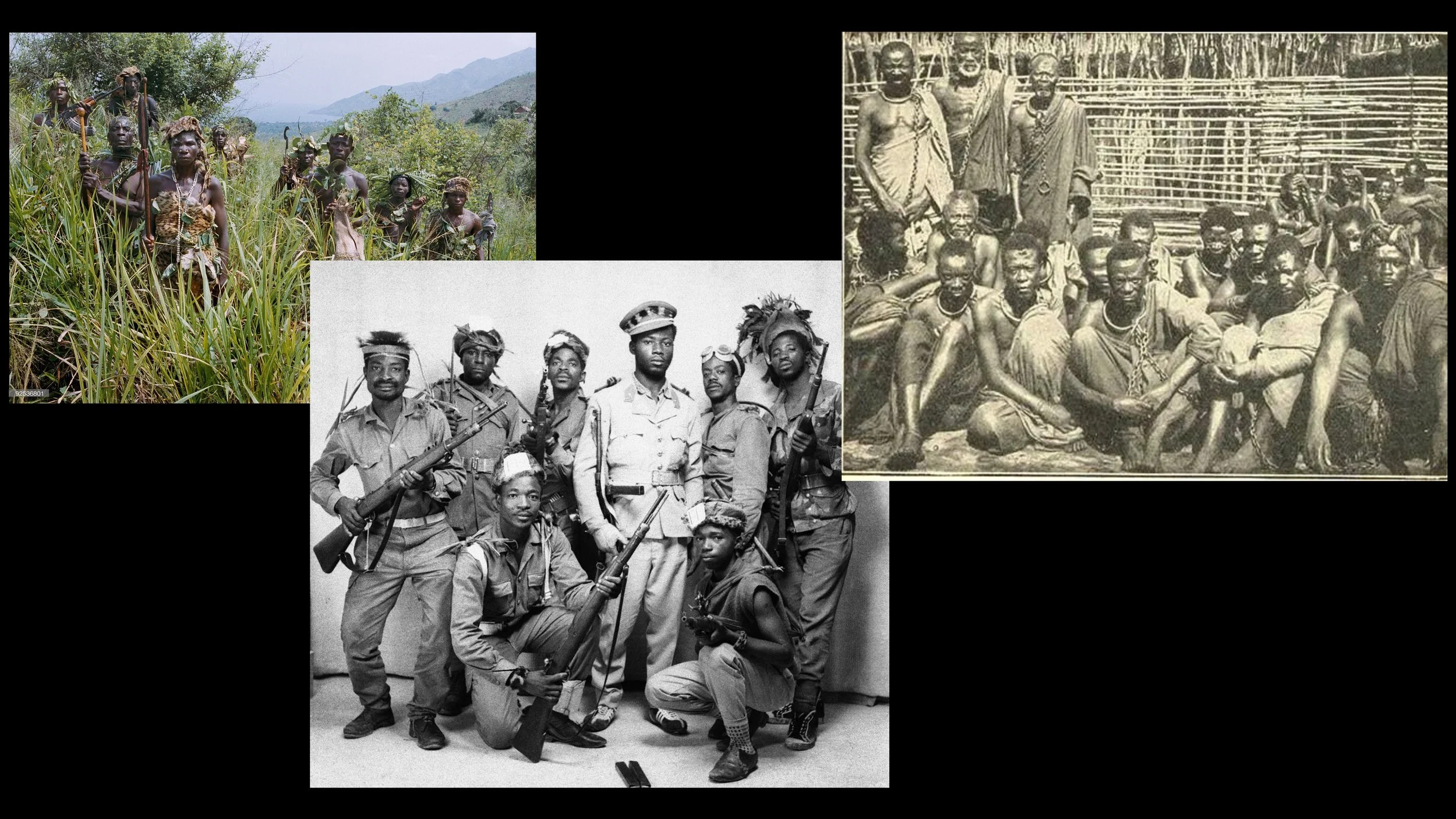
In 2004, researchers in the dense forests of Walikale territory in North Kivu, eastern Congo, encountered fighters from a militia calling itself Mai-Mai Simba. These armed men claimed their movement traced its lineage directly to the Simba rebellion of 1964, led by the followers of Patrice Lumumba against the regime ushered in by the neocolonialist coup in the Congo. The Simbas themselves drew on practices from the Maji Maji uprising against German colonialism in 1905. Indeed, the term "Mai-Mai" (or "Mayi-Mayi") itself reflects the Congolese pronunciation and spelling of the Swahili phrase "Maji-Maji," maji meaning "water."
Being familiar with the longue durée history of the interlacustrine region—the world surrounding the great lakes of East and Central Africa, connecting Burundi, Congo, Ethiopia, Kenya, Malawi, Mozambique, Rwanda, Tanzania, Uganda, and Zambia—I want to argue that this is a matter of profound significance. What the Mai-Mai practiced, protective medicine combined with moral discipline to organize collective defense, had persisted across generations, a theme whose variations adapted to new enemies.
I am going to attempt to trace that theme across 120 years, in its confrontation with four regimes of modernizing power—German colonialism, African nationalism, neocolonial clientism, and extra-colonial humanitarianism and developmentalism. Each regime that has confronted the Long Maji Maji has seen only primitive superstition, an obstacle to modernization, or an armed problem requiring pacification. This persistent misrecognition has helped ensure its repeated re-emergence. But to understand what is at stake, we must first understand what the formation emerges in response to.
The Warren: Three Scrambles for Africa
Picture the continent. Not the flat projection that shrinks Africa to a shape that fits between Europe and the Americas on a classroom wall. Picture the actual landmass: larger than the combined landmasses of China, India, the contiguous United States, and most of Europe combined, its forests holding the second lung of the planet, its soil sitting on geological formations older than complex life, its peoples connected by trade routes and language families and cosmological entanglements that preceded the colonial machine by millennia.
The history of racial capitalism's engagement with the African continent falls into three overlapping phases—what I call the three Scrambles—each building on the infrastructure of the last, each producing the conditions that activate the next wave of resistance.
The First Scramble for Africa, "The Slave Trade," was the proto-colonial competition to convert Africa into what Karl Marx called "a warren for the commercial hunting of black-skins": to kidnap and export enslaved Africans to the New World.
Consider what that phrase actually names. To hunt commercially is to reorganize a territory around the act of capture—to render a living world into a supply zone, its peoples into prey, its landscapes into corridors of extraction, its political orders into mechanisms of delivery.
And what was being extracted? Achille Mbembe gives us the term: ambulant suns. Living energy. Human flesh as fossil fuel. The enslaved were not merely laborers shipped to the New World; they were the energy source of an entire industrial order—bodies burned through like coal to power the terraforming of Turtle Island, Abya Yala, and Pindorama into Neo-Europes. In the deadliest plantation regimes, the average remaining lifespan of a trafficked African was reckoned at seven years. Seven years of labor extracted, then death, then replacement. For roughly the first two of its four centuries, the plantation regime did not depend on the reproduction of its labor force. It depended on the continuous extraction of new fuel from Africa.
According to the more maximalist UNESCO estimates, between twenty-five and thirty million of these ambulant suns were kidnapped, deported, and subjected to slavery and social death across four centuries. When you account for those killed during and in the long destructive wake of slave raids, in holding camps, on death marches to coastal ports, and during the Middle Passage, the total number of lives lost on the continent may be reckoned at one hundred million.
And this is to say nothing of those who remained on the continent, surviving half-lives in the wake of those apocalyptic disappearances. These were not merely the destruction of peoples. They were the rending of social fabric: trade routes severed, governance systems shattered, architectures of knowledge and relation razed. Whole civilizations did not vanish; they were hollowed out, left standing but emptied of the kinship, continuity, and collective capacity that had made them what they were.
For Africa to function as a warren, the warren had to be built. Consider what must be done to a region before its oil becomes extractable—the roads cut, the rivers poisoned, the communities displaced, the governance captured, the land itself remade into a delivery system for what lies beneath it. The slave trade required its own equivalent: a vast, destructive infrastructure laid down across the continent and maintained across centuries. Fortified trading posts along the coast. Inland networks of coerced intermediaries. The systematic destabilization of societies that resisted conscription into the supply chain. The militarization of those that cooperated. The deliberate production of chaos in regions targeted for raiding, so that war itself became the engine of capture. This infrastructure was not incidental to the transatlantic slave trade. It was its other half—the half that remains most invisible, because it was designed to look like the natural condition of the continent rather than the manufactured ruin it was.
The Second Scramble for Africa, "The Land Grabs," began in the wake of the "non-event of emancipation" and the closing of the frontiers of the New World. It marked the full-blown colonial campaign to conquer, exploit, and dominate the African continent through extreme violence.
The speed of this conquest is often treated as evidence of African weakness. But it was evidence of the First Scramble's success. Four centuries of the warren had already done the work: governance systems shattered, trade networks redirected toward the coast, societies militarized against one another, populations depleted by a hundred million lives extracted or destroyed. Europeans did not conquer a healthy body but a patient they had spent centuries bleeding.
The intermediaries the First Scramble had empowered—local rulers coerced or co-opted into supplying the trade—were now overthrown by the same Europeans who had enriched them. Having served their purpose as franchise managers of the warren, they were discarded. Europeans declared themselves the continent's new "enlightened" governors.
Despite claims of having abolished slavery, they reconstituted its horrors in the interior of Africa. The Congo Free State became the most infamous example: a vast plantation-state where forced labor and terror killed an estimated ten million Congolese people in less than twenty-five years. Hands severed to meet rubber quotas. Villages burned. Children held hostage. And the Congo was not unique. Across the continent, similar regimes extracted labor and life.
The political economist Issa Shivji describes the economy these regimes installed as "typically disarticulated, almost tailor-made, for exploitation by colonial capital." Extractive industries predominated. The urban and the rural became two countries within one: one alien, modern, barred to the native—while the other was frozen in so-called tradition. Neither was organically so. Both were colonial constructs. This was not dysfunction. It was production organized to answer the accumulation needs of the center, not the survival needs of the periphery.
The Third Scramble for Africa, "The Debt Trap & Resource Curse," is the ongoing neo-colonial and extra-colonial campaign to underdevelop and overburden postcolonial African states through debt repayments, natural resource exploitation, skilled labor migration, and political subservience to global economic blocs.
The continuity matters. The First Scramble hollowed the continent to fuel Empire. The Second walked into the hollowed body and installed direct rule. The Third inherits everything the first two built and broke: borders drawn to divide ethnic communities, economies structured around single export commodities, education systems designed to produce clerks rather than sovereign thinkers, governance institutions modeled on the colonial state and handed over with the instructions still written in the colonizer's language. What the world calls African dysfunction is not a failure to develop. It is the warren still functioning.
The Third Scramble recalls the dynamics of the First. Instead of imposing direct rule, neo-colonial enterprises bribe, corrupt, and terrorize postcolonial elites into sabotaging their nations' futures. These elites function as agents of systemic underdevelopment, reminiscent of early modern African rulers coerced into selling their most vulnerable subjects into chattel slavery. The mechanism is uncannily similar: identify local actors, bind them to external interests, let them administer the extraction so the extractors can claim clean hands.
Shivji's concept of disarticulated accumulation names the structural logic: what is produced is not consumed and what is consumed is not produced. Africa exports its coffee, cocoa, cotton, gold, diamonds, copper—almost none with robust internal markets to sustain them. The surplus generated in agriculture is not accumulated within agriculture to propel its development. It is extracted upward through compradorial intermediaries and outward to the imperial cores. Today, Africa loses more through capital flight, unequal trade, and brain drain than it gains through aid, foreign investment, or remittances. If not for the global economy's rigged infrastructures, Africa would be a net creditor to the world.
But Africa is burdened with debts designed to be unpayable, ensuring permanent dependency. In this way, decolonization was, in effect, the transfer of the administration and operating costs of the warren to its inmates.
This is what the Long Maji Maji resists. Not a single regime but an apparatus that reconfigures across centuries—an apparatus whose economic logic structurally ensures that the periphery generates surplus it can never accumulate, serves needs it can never meet, and depends on institutions that can never protect. The Long Maji Maji formation resists through means that every version of that apparatus has declared illegitimate—not because those means are ineffective, but because recognizing their legitimacy would undermine the foundational claim that sovereignty must flow through centralized institutions the apparatus controls.
The Long Maji Maji
The practice of ritually treated water conferring protection on warriors existed across the interlacustrine world before the Maji Maji rebellion that I take as my exemplar here. Indeed, the earliest evidence of its usage is found amongst populations who employed water infused with spiritual power against Arab slave raiders in the West Nile region of Uganda, in the adjoining area of the Democratic Republic of the Congo and South Sudan during the nineteenth century.
The Maji Maji uprising in German East Africa, the largest African rebellion against European colonialism, drew on this practice becoming its most famous instance. The context was the Second Scramble at its most brutal: German authorities attempting to refashion territories into cotton zones through forced labor actively modeled on the neoslavery of Black sharecroppers in the American South.
A healer named Kinjikitile Ngwale, claiming possession by the spirit Hongo, began distributing maji—water treated with medicinal herbs said to neutralize ammunition. But the medicine came with strict requirements: sexual abstinence preventing the use of rape as weapon of war, food restrictions, behavioral discipline. These prohibitions created boundaries marking who belonged to the protected community. The practice addressed two problems simultaneously: the lack of unity among different populations, and the massive military disadvantage. Ritual achieved what political organization alone could not.
The Germans hanged Kinjikitile, but the practice had already proliferated through dispersed specialists called hongo who prepared maji across multiple ethnic groups. Scorched earth tactics eventually crushed the rebellion—burning villages, destroying crops, producing famine that killed as many as 300,000 people. But the constellation of practices Kinjikitile activated had proven its capacity: disparate marginalized populations converted into organized fighting force through cosmological alignment rather than bureaucratic control. The Germans won militarily but encountered something they could not fully suppress. After the defeat, the symbolic repertoire was taken up by prophetic figures leading purification movements—maintaining the grammar while redirecting it from warfare to internal transformation. The practice-knowledge survived in communities across the region, available for transmission when crisis would demand it again.
Nationalist Appropriation in Tanzania
When Tanzania achieved independence in 1961, Nyerere encountered Maji Maji as powerful but dangerous inheritance. The rebellion offered exactly the narrative nationalist historiography required: unified resistance by diverse peoples against foreign oppression. But its actual character—dispersed ritual networks, cosmological authorization exceeding political ideology, legitimacy derived from demonstrated capacity rather than institutional frameworks—threatened the centralized state Nyerere was building.
Shivji describes the structural trap. The colonial economy was anything but national. Imperial policy left behind extremely uneven development. And the social class that inherited power at independence was, in Frantz Fanon's formulation, an underdeveloped middle class with practically no economic power—not engaged in production, nor in invention, nor building, but completely canalized into activities of the intermediary type. There was no bourgeoisie capable of shouldering national development. The task fell entirely on the state.
Nyerere's developmental state thus became both the agency of national transformation and the site of accumulation. The public sector expanded rapidly, financed by draining surpluses from the peasantry. State-run marketing boards—which Shivji identifies as the great invention of the British to enable surpluses from the colonies to finance metropolitan reconstruction—became the mechanism for siphoning surplus out of agriculture. The nationalist vision called for revolutionary transformation, but the state carrying it out was itself colonial heritage: a despotic state, a metropolitan police and military outpost, in which powers were concentrated and centralized, where law was an unmediated instrument of force.
This is why Nyerere could celebrate Maji Maji and suppress its grammar simultaneously. The developmental state needed centralized accumulation. Dispersed cosmological authority threatened the very monopoly through which surplus extraction operated. The nationalist solution was epistemic appropriation: claiming Maji Maji as origin story while suppressing what made it threatening. The 1968 Maji Maji Research Project at the University of Dar es Salaam created the authoritative account emphasizing anti-colonial unity and heroic leadership—Maji Maji as proto-nationalist moment leading inexorably to independence and the post-colonial state. Meanwhile, the living grammar was delegitimized as primitive regression.
The suppression was simultaneously celebratory and destructive: monuments erected, schoolbooks written, the actual practice-knowledge driven underground. Yet it could not be eliminated because it operated through informal transmission resistant to bureaucratic control. Veterans remembered. Communities maintained knowledge. When crisis demanded reactivation, the grammar was available.
Fanon was aware of this fact when he wrote in Wretched of the Earth: "The memory of the anti-colonial period is very much alive in the villages, where women still croon in their children's ears songs to which the warriors marched when they went out to fight the conquerors. [...] At twelve or thirteen years of age the village children know the names of the old men who were in the last rising, and the dreams they dream in the douars or in the villages are not those of money or of getting through their exams like the children of the towns, but dreams of identification with some rebel or another, the story of whose heroic death still today moves them to tears."
The Simba Rebellion, 1964–1965
Patrice Lumumba's assassination in January 1961—murdered in Katanga, his body dissolved in acid, the coup backed by Belgium and the United States—installed the exemplary neocolonial regime. Mobutu emerged as strongman. Congo became the textbook case of Shivji's compradorial path: formal independence masking continued extraction, African elites functioning as intermediaries for foreign interests, maintaining extractive structures under the flag of sovereignty.
When Gaston Soumialot was tasked with organizing rebellion in eastern Kivu, he faced the same problem Kinjikitile had faced sixty years earlier: how to mobilize marginalized populations against a militarily superior enemy that claimed to govern them. The answer came across Lake Tanganyika. Tanzanian advisors brought the knowledge that had survived Nyerere's nationalist appropriation: the practice of maji to protect warriors and mobilize resistance. The forces that emerged—the Simbas—were overwhelmingly young, mostly twelve to twenty, an age group colonialism and failed independence had devastated. They underwent ritual baptism, received dawa, observed prohibitions paralleling Kinjikitile's: celibacy, honesty, bodily austerity, dietary restrictions. The formation provided what the neocolonial state could not: moral community, authorization for resistance, transformation of youth with no prospects into an effective fighting force.
The effects were dramatic. Government soldiers frequently fled without fighting. Forty Simba warriors captured Stanleyville from a 1,500-man garrison without firing a shot. By mid-1964, the rebels controlled half of Congo. But Western powers intervened—Belgian paratroopers deployed by American aircraft, white mercenaries from South Africa and Rhodesia. By late 1965, the rebellion was militarily crushed. Yet Laurent-Désiré Kabila, one of the Simba commanders, maintained small insurgent forces near Lake Tanganyika for three decades. The grammar survived because it operated through dispersed knowledge transmission rather than institutional continuity.
Mai-Mai in Collapsing Kivu, 1990s–Present
By the 1990s, Mobutu's regime had completed its transformation into pure predatory apparatus. Structural adjustment programs imposed by the Bretton Woods Institutions systematically dismantled even the modest achievements of the developmental period. Social indicators—education, medical care, health, nutrition, literacy, life expectancy—all declined. What your average development analyst calls "state failure" in eastern Congo is the terminal stage of this process: not that the state withered naturally but that its developmental capacity was systematically destroyed from outside while its extractive capacity was preserved.
In eastern Kivu, Mobutu's 1973 land law made all land state property, destroying customary tenure—precisely what Shivji theorizes as sovereignty and property merging in the state, extra-economic coercion playing a central role in peasant production. Political elites seized vast tracts for personal ranching. Then, after the 1994 Rwandan genocide, over a million refugees—including former genocidaires—flooded into Kivu. Youth faced total marginalization.
The ground-level reality producing Mai-Mai recruitment is what Shivji identifies as labour subsidizing capital. Unable to survive on the land, peasants seek casual activities—petty trading, craft-making, construction, gold-scrapping. Foreign researchers celebrate these "multi-occupations" as diversification and the "end of peasantry." It is nothing of the sort. These are survival strategies in which peasant labour super-exploits itself by intensifying work across multiple occupations while cutting necessary consumption. The youth who become Mai-Mai are already inside a system of super-exploitation that structurally cannot provide what it promises. They are Fanon's Wretched of the Earth. The Maji Maji or Mai Mai formation offers what the economic apparatus withholds: protection, status, participation in collective power.
The earliest Mai Mai militia formations in Kivu included groups composed substantially of Simba veterans. When violence escalated in 1993, traditional chiefs sought out these veterans as custodians of the protective medicine tradition. New fighters were initiated through scarification, medicinal preparations pressed into wounds, bodies doused with ritually treated water. The behavioral requirements were extensive: prohibitions on sexual contact, theft, certain foods, washing with soap. When government troops heard of Mai-Mai approach in 1996, they fled—the same pattern as 1964, the same pattern as 1905.
Today, dozens of Mai-Mai groups operate across Kivu. Their fragmentation is not organizational failure but structural characteristic: dispersed networks coordinating without centralized command, different docteurs preparing medicine according to local variations, all participating in shared grammar. They fight against Rwandan-backed rebels, Ugandan insurgents, their own predatory national army, and—since 2000—humanitarian intervention, which classifies them as "armed groups" requiring demobilization. Disarmament, Demobilization, and Reintegration (DDR) programs consistently fail because they address consequences while ignoring causes.
The Longue Durée
The Long Maji Maji belongs to a global pattern. Between 1890 and 1910, similar formations emerged wherever populations faced apocalyptic violence with massive military disadvantage: the Ghost Dance across North American Plains nations in 1890, the Boxer Rebellion in northern China from 1899 to 1901, Maji Maji in German East Africa from 1905. All three were militarily crushed. All three were dismissed as primitive superstition. I have attempted to demonstrate here that the dominant account is false for Maji Maji. Whether Ghost Dance or Boxer formations have similarly persisted, transformed, and reactivated under new conditions—that work must be done by those who carry the knowledge.
But what I want to argue about the Long Maji Maji is that as long as the economy is organized to generate surplus it cannot accumulate, to serve centers it cannot reach, to depend on institutions that cannot protect—its grammar of resistance will persist. Under disarticulated accumulation, capital shifts the burden of social reproduction to labour. The dominant tendency is semi-proletarianization, in which the worker super-exploits himself by cutting into necessary consumption—accumulation by dispossession. The Maji Maji formation had activated precisely in the gap between what peripheral capitalism extracts and what it refuses to provide.
Sovereignty organized outside state frameworks has never been eliminated despite more than a century of sustained suppression across fundamentally different political regimes. Modernizing power's claimed necessity is contingent, its forms particular, its alternatives persistent. Until it can recognize cosmological authority as legitimate rather than primitive, dispersed networks as political rather than criminal, pathological, underdeveloped, ritual discipline as governance rather than superstition—the Maji Maji formation will continue its pattern of transmission and return. Not as failure. As evidence that when regimes claiming monopoly on legitimate violence repeatedly fail to protect, populations will turn to what works.
I want to close with a tension rather than a resolution.
Fanon knew the grammar I have been describing. In Wretched of the Earth, he writes about the dance, the possession, the ritual barriers, the cosmological organization of colonized peoples. And he read them as a phase—something the colonized pass through on their way to political consciousness. The native who finally takes up the gun, Fanon writes, "discovers reality" and pours scorn upon "the zombies of his ancestors, the horses with two heads, the dead who rise again." The circle of the dance gives way to the clarity of armed struggle. Ritual is the chrysalis. Revolution is the emergence.
Cabral saw something different. He writes, in the essay "National Liberation and Culture," that culture is not the chrysalis to be shed but the seed awaiting germination. "Like the seed which long awaits conditions favorable to germination in order to assure the survival of the species and its development," he writes, "the culture of African peoples flourishes again today, across the continent, in struggles for national liberation." Where Fanon sees the passage from ritual to revolution as a radical break, Cabral sees deep continuity. Culture "takes refuge in the villages, in the forests and in the spirit of the generations who were victims of colonialism." It survives repression, persecution, betrayal. And when conditions shift, it does not return from the dead. It germinates. It was never not alive.
The Long Maji Maji is Cabral's seed. The practice-knowledge that Kinjikitile activated in 1905 took refuge in exactly the places Cabral names—villages, forests, the spirit of generations. It crossed Lake Tanganyika. It was carried by Simba veterans into 1990s Kivu. It germinated each time because it had never died.
But I do not believe Fanon is wrong. And neither does Cabral. Both demand more than persistence. Fanon's "Pitfalls of National Consciousness" is an extended warning: independence without political education, without breaking the compradorial class, without transforming the economy, is not decolonization. It is the transfer of administration. Cabral says the same from the other direction: if liberation does not produce "a significant leap forward of the culture of the people who are liberating themselves," then "the efforts and sacrifices accepted during the struggle will have been made in vain." Culture survives—Cabral is certain of this. But survival is not liberation. The seed persists, but if the conditions for germination never fully arrive, what you get is not the flowering but the endless recurrence of the same desperate sprouting, in the same depleted soil.
This is what has happened in the interlacustrine world. Not once, in 120 years, has a regime done what Fanon and Cabral both demand. Nyerere celebrated Maji Maji and drained the peasantry. Mobutu installed the exemplary kleptocracy. The humanitarian apparatus manages armed groups while the minerals flow outward. The precondition for Fanon's emergence has never been met. The conditions for Cabral's germination have never arrived. And so the people do not revert to the Maji Maji grammar. They were never converted from it. You cannot revert to what you never left.
The formation persists not because Fanon is wrong about what liberation requires, but because what he requires has never been provided. The grammar holds because the space both he and Cabral say the revolution should fill remains empty.
But here I want to push further—beyond Fanon, and even beyond Cabral. Because both of them, for all their diagnostic brilliance, still identify revolution with modernizing power. Both assume that the dispersed formation must eventually yield to the centralized movement, that cosmological authority must eventually be absorbed into political program, that the seed must flower into the state. What if the lesson of the Long Maji Maji is not that revolution has been delayed but that revolution, as we have inherited the concept from the West, from the colonizer, is itself part of the apparatus?
Revolutions that have claimed to liberate the colonized have inherited the colonial state and suppressed the dispersed formations—like the Long Maji Maji—that actually protect populations when centralized institutions fail. And they have called this suppression progress.
So I leave you with three questions.
First: what does revolution here in the imperial core mean if it doesn't involve making reparations to the peoples whose wealth it stands on? If the wealth it redistributes was extracted from the periphery and the revolution has no intention of giving it back? Mustn't revolution also mean reparation?
Second: what does revolution here in the imperial core mean if the cosmologies of its colonized and racialized others—Indigenous and Black—are treated as culture to be celebrated or as raw material for its symbols, rather than as knowledge to be followed and sources of its governance? Mustn't revolution also mean reorientation?
Third: what are we to make of the fact that every prevailing idea of revolution identifies it with modernizing power? What do we make of a revolution that inherits the apparatus it claims to overthrow, suppresses the dispersed formations that actually protect populations when institutions fail, and calls this suppression progress? Mustn't revolution also mean renunciation?
Selected Sources
Eriksson Baaz, Maria, Judith Verweijen, and Jason Stearns. "The National Army and Armed Groups in the Eastern Congo: Untangling the Gordian Knot of Insecurity."
Giblin, James, and Jamie Monson, eds. Maji Maji: Lifting the Fog of War.
Jourdan, Luca. "Mayi-Mayi: Young Rebels in Kivu, DRC."
Malekela, Samson Peter. "In Pursuit of Continuity: Maji Maji War and Nationalistic Movement in 1940s-1950s in Southern Tanganyika."
Prunier, Gérard. Africa's World War: Congo, the Rwandan Genocide, and the Making of a Continental Catastrophe.
Shivji, Issa G. Accumulation in an African Periphery: A History of Labour and Livelihood in Tanzania.
Shivji, Issa G. Class Struggles in Tanzania.
Wild, Emma. "'Is It Witchcraft? Is It Satan? It Is a Miracle': Mai-Mai Soldiers and Christian Concepts of Evil in North-East Congo."