Colonial → Neo-Colonial → Extra-Colonial
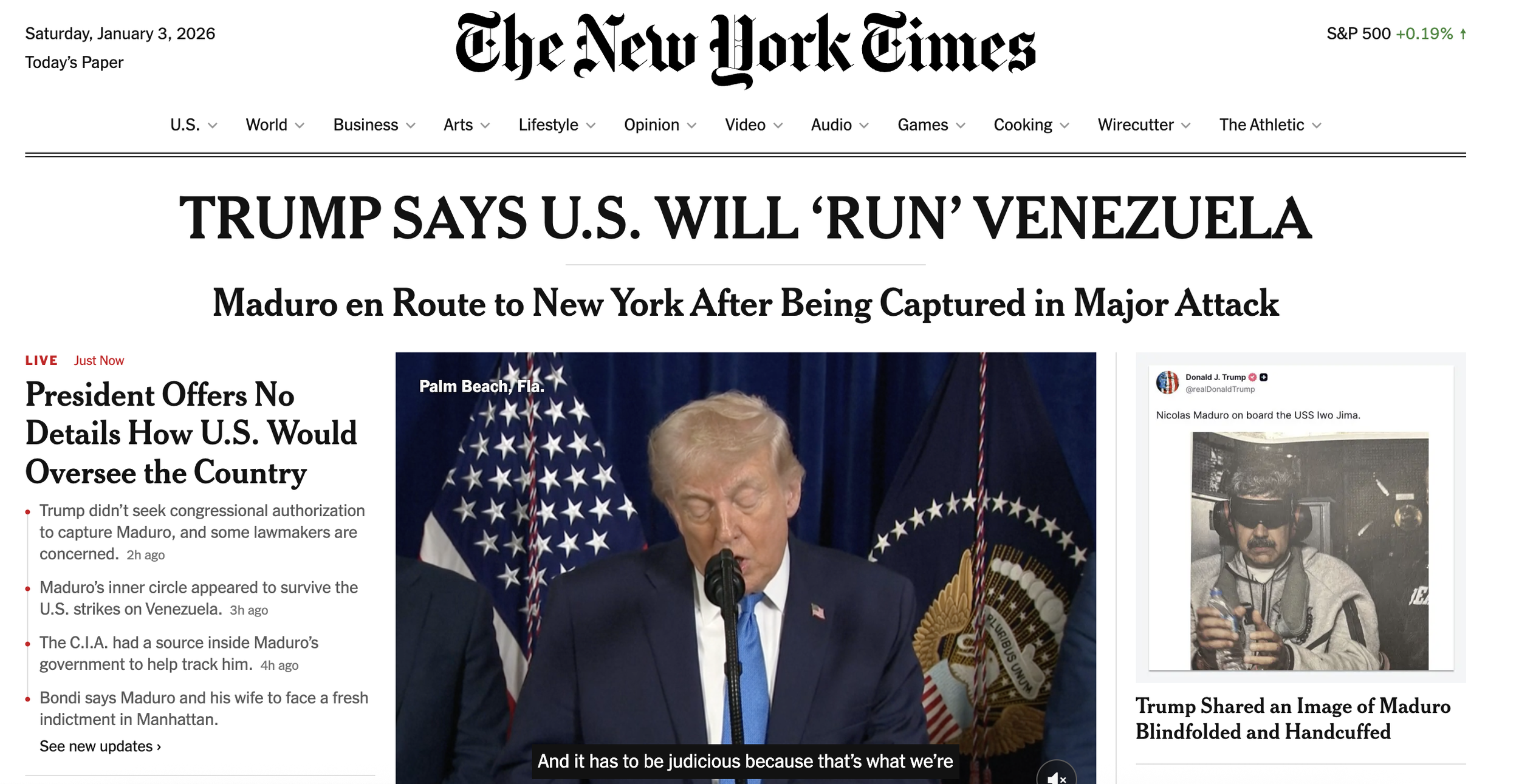
Hours after explosions were heard in Caracas, the United States announced it had captured Nicolás Maduro and flown him out of Venezuela. Headlines framed the operation as regime change, the latest chapter in a long history of US intervention in Latin America. Commentators invoked Guatemala (1954), Chile (1973), Iraq (2003). Critics warned of another failed attempt at nation-building. Supporters anticipated democratic transition.
The regime-change frame is understandable. Trump announced the US would “run the country” until a “safe, proper and judicious transition,” and spoke of American oil companies remaking Venezuela’s energy infrastructure. It sounds like the neocolonial playbook: install a friendly government, manage extraction, bear responsibility.
But rhetoric and outcome are not the same. The operation installed no client government. It occupied no territory. It offered no details about how, or for how long, or by whom Venezuela would be governed. What it produced was a decapitation: a declared rival’s asset removed, flown to New York to face charges, while the country’s future remains undefined.
If the pattern of Iraq, Afghanistan, and Libya holds, what follows will not be stable governance under American auspices. It will be something else that requires stepping back to notice how imperialist war itself has transformed.
In the colonial era, imperialist war was territorial. Victory meant claiming land, planting flags, drawing borders, extracting resources through direct administration. In the neocolonial era, imperialist war shifted to regime change. Direct territorial control proved costly; the strategy became installing friendly governments—clients who would manage extraction on behalf of metropolitan powers while bearing local responsibility.
Now a third logic prevails. In the era of extra-colonial competitive control, even regime change becomes unnecessary—often counterproductive. The question is no longer “who holds the state?” but “which armed actors operate in the territory, and whose interests do they serve?” Who needs a regime when there are war machines friendly to one’s interests?
In the emerging multipolar landscape, where no single bloc can monopolize territory or resources, war machines flourish. War machines are armed formations that straddle armies, businesses, and political factions: militias, mercenary firms, paramilitaries, insurgent groups, cartels, private security contractors. They thrive where central authority is weak, resources are rich, and multiple powers have interests.
They are not failures of the state system. They are functional alternatives to it. Where regime change would require the costly work of building and maintaining a client state, war machines offer something more flexible: armed actors who can secure resource flows, disrupt rivals’ logistics, terrorize populations into compliance, and provide plausible deniability—all without the overhead of governance.
Eastern Congo set the paradigm. It sits atop cobalt, coltan, and minerals essential to batteries, smartphones, electric vehicles—the hardware of surveillance capitalism and the green transition. The region is far from effective state control, yet crowded with competing actors: neighboring governments, multinational corporations, local elites, peacekeeping forces, NGOs, dozens of armed groups. These war machines tax miners, loot convoys, terrorize villages, cut deals with officials and executives. They are not chaos. They are flexible connectors between global supply chains and local dispossession.
Similar patterns mark the planet’s friction zones. The Sahel: Wagner Group and local militias contest French and American influence over uranium, gold, migration routes. Yemen: Houthis, UAE-backed forces, Saudi operations, Al-Qaeda franchises create permanent crisis that suits multiple parties. Syria: the state barely functions, but Russian bases, Turkish buffer zones, Kurdish autonomy, Iranian proxies, Israeli occupation coexist in competitive equilibrium. Myanmar: military, ethnic armies, and pro-democracy forces contest jade, timber, rare earths, and transit routes—while China arms multiple sides and brokers ceasefires to protect extraction corridors. Latin America: “cartel violence” as screen for competing state and para-state protection rackets—police, military, politicians shaking down traffickers while claiming to fight them.
In each place, multiple blocs—United States, Europe, China, Russia, Gulf petro-kingdoms, regional powers—test doctrines, sell weapons, secure access to resources, outsource atrocities. This is what counterinsurgency theorists call competitive control: multiple armed actors competing to be the one who can credibly threaten, protect, or abandon you.
A militia “allows” you to farm in exchange for a cut and a son sent to the bush to learn to fight. The national army secures a road only long enough for a convoy of aid and/or ore to pass. A UN base provides refuge for some while neighboring villages burn. An international NGO distributes food that stabilizes a camp, which stabilizes a front line, which stabilizes a resource corridor.
Each actor produces a local, temporary, conditional order. None needs the others to fail. They coexist because none claims totality. The population learns to read which authority controls which road at which hour, which checkpoint belongs to whom this week, which uniform means extraction and which means worse.
The “failed state” discourse frames these situations as absences—of law, sovereignty, development. But competitive control zones are not empty. They are saturated with armed actors, each offering a partial, conditional, revocable claim to security. The population experiences not a lack of governance but an excess of competing governors—none responsible for the whole, all extracting from their slice.
This arrangement serves Empire’s infrastructure even without—especially without—a single hegemon controlling the territory. Resources flow out. Cobalt reaches Shenzhen and Seoul. The supply chain doesn’t require peace; it requires passable corridors, which competitive control provides in fragments.
No one is responsible. When atrocities occur, attribution dissolves: the militia did it, or the army, or unknown armed men. Corporations maintain “conflict-free” certifications by laundering ore through enough intermediaries. States deny command responsibility. NGOs document but cannot prevent.
Rivals are denied consolidation. Neither China nor the US nor any regional power can build stable infrastructure in a competitive control zone. Roads get built and blown up. Ports change hands. Investment remains perpetually at risk. Populations are pacified through exhaustion. When survival requires constant negotiation across multiple armed actors, political mobilization becomes nearly impossible. Energy goes to navigating the immediate. Resistance fragments along the same lines as control.
Colonial and neocolonial war persist. Israel’s occupation of southern Syria has territorial dimensions. The US capture of Maduro carries echoes of regime change. But these are not the governing logics. They are residues, habits, sometimes deliberate misdirections. The prevailing logic is extra-colonial: competitive control through war machines, not territorial annexation, not client state installation.
The confusion is not academic. It produces practical misreadings.
When analysts see Venezuela, they expect regime change: a friendly government installed to manage extraction. Trump’s rhetoric reinforces the expectation—“run the country,” “safe, proper and judicious transition,” oil companies remaking infrastructure. It sounds neocolonial. Yet the outcome so far is simpler and stranger: no announced governance, no stated timeline, no clear mechanism of rule—only removal, extradition, and an undefined future. If the pattern of Iraq, Afghanistan, and Libya holds, what follows is not stable client governance but contested fragmentation: armed factions competing for territory and resources, external powers positioning for advantage, no one assuming responsibility for the whole. The US may not need a Venezuelan state. It may need Venezuela unavailable to China and Russia, its oil accessible to American firms, its governance problem belonging to someone else. Fragmentation can serve this purpose as well as—perhaps better than—occupation.
When analysts see Israel in Syria, they expect territorial expansion: annexation, settlement, incorporation. But Israel has not annexed the buffer zone. It builds fortified outposts while refusing sovereignty claims. It provides services to Druze villages while conducting raids that kill villagers. This is not colonization as administration. This is competitive control: permanent presence without governance, security provision that produces insecurity, protection that creates the enemies it claims to protect against.
When analysts see Trump’s threats to Iran, they expect regime change: coups, client installation. But the conditional trigger is not a promise to rebuild Iran under American auspices. It is a promise to degrade—strikes on missile facilities, command nodes, IRGC infrastructure—weakening the state’s coercive capacity without assuming responsibility for what follows. If Iran fragments into competing IRGC factions, Kurdish insurgents, Baluchi militants, MEK cells, regime remnants—so much the better. A fractured Iran serves US interests more than a client Iran would, and costs far less.
When analysts see Sudan, they expect international intervention to end conflict—the humanitarian logic imagining the “international community” as neutral arbiter. But the Quad calling for ceasefire while its members arm both sides is not failure. It is the system working. The UAE arms the RSF. Egypt and Saudi Arabia back the SAF. All four issue statements deploring violence. The war continues. Resources flow out. El-Fasher burns. This is not incoherence. This is competitive control operating through sponsors who want their war machine to gain advantage without being held responsible for outcomes.
When analysts see Nigeria, they expect counterterrorism—security logic taking stated rationales at face value. But Christmas Day strikes on Sokoto, a predominantly Muslim state with minimal ISIS presence, hitting empty fields with no casualties, are not counterterrorism. They are subordination theater: performative violence extracting Nigerian compliance with US narratives regardless of local realities. The bandits, the kidnappers, the elite collusion with illegal gold mining—none of it touched. Touching it was never the point.
When analysts see Ukraine, they expect great power war—spheres of influence, territorial integrity, victory or defeat. But the conflict has evolved beyond these frames. Neither side pursues clean resolution. Russia cannot conquer and govern Ukraine; it can fragment, attrit, partition. The US and NATO cannot defeat Russia outright; they can degrade its capacity, drain its resources, prevent consolidation. What emerges is not victory but the conditions for competitive control: a zone where neither bloc achieves hegemony but both maintain position; where the war continues because continuation serves sponsors better than resolution; where Ukrainians—like Congolese, Sudanese, Yemenis, Syrians—bear the cost of an arrangement designed for external benefit.
Again, colonial and neocolonial violence have not disappeared. They persist as residues, habits, misdirections.
Residues: Israel’s settlement expansion in the West Bank remains classically colonial—territorial acquisition, population transfer, sovereignty claims. But this is increasingly anomalous, sustained by ideological commitment and domestic politics rather than imperial rationality. The buffer zone in Syria operates differently.
Habits: US foreign policy institutions still speak the language of regime change because that is what they were built to do. But the outcomes they produce—Libya, Iraq, Afghanistan, now Venezuela—are not functioning client states. They are competitive control zones. The institution’s stated logic and its actual effects have diverged.
Misdirections: rhetoric of territorial expansion or regime change can serve as cover for competitive control. Analysts who take rhetoric literally miss what is happening. Trump’s language about Venezuela—drug cartels, stolen territory, stolen oil—sounds like colonial justification. But the operation produced decapitation without occupation, not annexation.
The diagnostic error has consequences.
For solidarity movements, organizing against “US imperialism” expecting neocolonial regime change prepares for the wrong fight. You anticipate a client government to oppose. Instead you get fragmentation, war machines, no clear target. Your analysis becomes incoherent.
For affected populations, if international actors expect regime change, they position themselves to influence the new government. But there may be no new government coming—only competitive control. Positioning for influence over a state that won’t consolidate becomes wasted effort.
For peace processes, if mediators expect to negotiate transitions to stable governance, they misunderstand what sponsors want. Sponsors don’t want stable governance. They want their war machine to gain advantage while conflict remains managed. Peace processes become performance—ceasefire negotiations while arms shipments continue.
For humanitarian response, if aid organizations expect to operate in a power vacuum awaiting restoration of order, they misunderstand their structural position. They are not neutral actors in temporary absence of governance. They are one more actor in a competitive field, their operations producing positional effects—stabilizing camps that stabilize front lines that stabilize resource corridors.
None of this means the neocolonial playbook won’t be tried in Venezuela. Again, Trump says the US will “run” Venezuela. Oil companies are already positioning for contracts. There may be attempts at occupation, at client installation, at managed transition.
But these attempts will be half-hearted. They will be underfunded, understaffed, abandoned when costs rise or attention shifts. They will be tried the way Iraq was tried, the way Afghanistan was tried, the way Libya was tried—with enough commitment to profit from the destruction, not enough to rebuild.
Again, the neocolonial playbook persists as habit, as rhetoric, as misdirection. But extra-colonial competitive control is the structural basis—the logic that explains why interventions produce fragmentation rather than governance, why sponsors arm both sides, why peace processes perform without resolving, why the wars continue.
We need to abandon the expectation that Empire still wants to rule. It wants to extract, and extraction doesn’t always require rule.