Pointers for Black Phenomenology
This essay begins with a text by Brian Massumi in one hand, one by Sara Ahmed in the other, and Hortense Spillers sparking in my nervous system, haunting my memory. Reading the opening of Parables for the Virtual alongside “A Phenomenology of Whiteness,” I realized that the question I wanted to pose to Massumi was not quite the one he was asking himself, nor the one Ahmed would ask, but one that Spillers might.
It was in the context of a reading group, sitting with friends and collaborators trying to work out how we might learn, research, and make things together across disciplinary, institutional, and cultural boundaries. Each of us was using these thinkers as tools for our own purposes, and I did find them useful for mine. But as I read and re-read, I kept feeling around for something that wasn’t quite there yet.
Massumi wants to know how bodies act out in ways that exceed the comprehension and comprehensiveness of cultural grids that are purported to script their every possible move. I don’t reject that question. I share his sense that bodies are more than local embodiments of ideology, more than coordinates on a map that can never quite capture the territory. But his question raises another one that has to come first for me: how do bodies get oriented toward the grid in the first place, and why does that orientation differ so sharply among differently coded bodies?
Put schematically, there are at least three basic orientations a body can inhabit in relation to what I’ll call the grid of power, and they are not evenly distributed. Subject: the world feels like a field of “I can.” Object: the world feels like a field of “I am for them.” Abject: the primary question is not how one appears, but whether, and in what form, one will show up at all in the path of force moving between subjects and objects.
My disagreement with Massumi is not that he is wrong to be interested in escape, but that his starting point sits closer to subject-orientation than to abject-orientation. I want to start from lower down on the social ladder, where the grid isn’t a metaphor and “disorientation” isn’t chic. Where the grid is a targeting system, and the first-person pronoun is a privilege you don’t inherit so much as earn under duress.
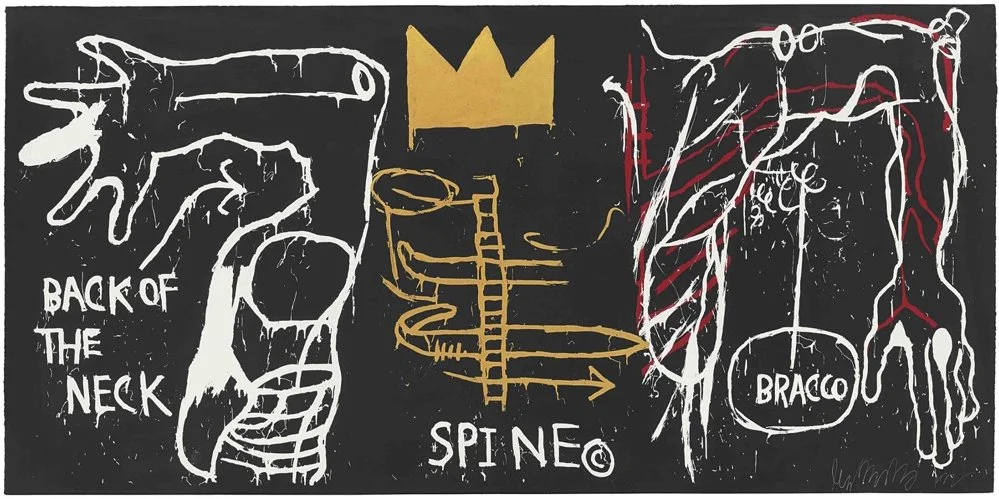
Jean-Michel Basquiat, Back of the Neck, 1983, silkscreen with hand painting.
I.
Classical phenomenology, at least in its canonical staging, invites us into a very particular room. A man sits at his desk, reaches for his cup, his cigarette, his doorknob, and wonders how the world shows up to him as something he can act in. How is his body such a reliable source of “I can”?
We’re told this is neutral: “the subject” facing “the world.” It isn’t. It is a white man in a room that has been cleared for him in advance. Land already stolen, walls already built, someone else already having scrubbed the blood, shit, crumbs, and fingerprints out of his field of view. The plumbing works. The locks click. The neighbors don’t call the cops when he raises his voice. He doesn’t have to earn any of that. He just calls it “the world.”
Yes, this is a cartoon. Husserl and Merleau-Ponty are more complicated than “white man at desk who trusts his furniture.” But as a diagram, the scene captures something crucial about the tradition’s default orientation: a subject whose basic question is how his embodied “I can” is possible, not for whom it is guaranteed and at whose expense. He wonders about the transcendental conditions for reaching the cup, not about the plantation, the colony, the prison, the zoning map that made that reach such a quiet, unremarkable act.
The world here is largely a field of affordances. The sliding doors into his building open when he walks toward them. Objects stay where they are put. If something glitches—a stuck drawer, a slippery floor—it is an anomaly to be explained, not the daily atmosphere of his life. His body is at home. His anxiety is metaphysical, not whether-today-is-the-day-I-get-shot-because-I-don’t-look-like-I-belong-here.
This “I” is not just male; it is white in the way whiteness likes best: as the default. His movements are pre-cleared as human, rational, legible. His reaching is never confused with reaching for a weapon, for contraband, for the wrong thing. He never has to rehearse how to place his hands before he reaches. He never has to practice looking harmless. He never has to wonder whether his very breathing will be misread.
He can afford to be bored with “the grid” because his body has never been pinned to it as a problem. When he isn’t pinning others to the grid for his own purposes, the grid is an epistemological nuisance for him, a conceptual narrowing.
II.
A later feminist phenomenology walks into this room and shifts the frame. Instead of focusing on the hand that reaches, it attends to the body that is reached for: the woman whose legs are commented on, whose waist is grabbed, whose presence is protected and threatened in the same breath. Iris Marion Young’s account of throwing “like a girl,” or descriptions of women’s bodies in public space, mark a different orientation: object-orientation. The central question becomes: what does it feel like to live as the thing within reach, the thing ready-to-hand for someone else’s subjectivity?
This is not a small correction. It fractures the assumption that embodiment is naturally at home in the world. It asks what happens when the world does not greet you with “I can,” but with “You are for me.” The white woman’s body is not allowed to simply move. It is watched, measured, ranked. She learns to feel eyes on her before she sees them, to shrink in advance, to walk with keys between her fingers. Her leg is not just what she walks with; it is what strangers claim with their gaze and hands.
But there is something else happening that “woman as object” does not quite capture. Yes, the white woman is an object inside a white world. Yes, she is a piece of furniture in the room. But she is the room’s centerpiece, the one that determines where everything else fits best. She learns early how to arrange nonwhite bodies as décor.
She knows how to make a Black friend, a brown lover, a mixed child function like the rip in her expensive distressed jeans, like the exposed brick in her renovated loft, like ornamental rust on the exposed beam in the café wall: signs of “edge,” curated roughness, damage turned into style. She hops in bed with a Black body, male or female, and somewhere in the unconscious—or just beneath consciousness, or maybe fully inside it—she thinks: my god, a white boy would love to watch this, would hate how much he loves it. And she gets off on titillating and spiting her internalized white male gaze. And the white boy does love/hate it. He loves/hates rips in jeans, exposed brick, ornamental rust; loves/hates Blackness as the tasteful tear in his smooth world.
She feels herself as object under his look (her overbearing father, her boss, her boyfriend, the cop, the professor) but she is also busy styling other people’s abjection into her texture. The nonwhite people around her become color and grain: the “spice” in her public profile, the proof that she is not like those other white women, the alibi that lets her demand safety while insisting she loves “diversity.” Her whiteness lets her walk away from the bodies she uses as aesthetic damage.
White feminist phenomenology is sharp when it names how patriarchy turns her into a thing for men. It is softer on how her whiteness lets her turn us into things that accessorize her in ways that attract or repel the white male gaze: props in her liberation narrative, characters in her sexual becoming, rips in her chic jeans.
So when I talk about the white woman as object, I mean an object with curatorial power. She is the thing within reach and the one who arranges which Black and brown bodies count as progressive backdrop, which can be safely consumed and stored as memory. She is sometimes extended into the world by whiteness, sometimes yanked back by patriarchy. But when she is extended, she often extends herself over us, using our flesh as texture so her own drama can look interesting.
III.
Black radical thought has to begin elsewhere. Spillers gives us a different starting scene: ungendered flesh in the hold of the slave ship and on the auction block. Here we are not primarily dealing with a gazing subject, nor even with an erotic object. We are dealing with limbs that become prosthetic extensions of the white male subject, and skins that can be draped over the white femme object like a fur coat. The room of phenomenology isn’t a room at all now. It’s a compartment. A cargo bay. A choke point in a supply chain where the body is already being translated into inventory.
The point is not that every enslaved person experienced themself in the same way, as if “flesh” were a single psychological mood. The point is that the dominant order treated their bodies as fungible parts in someone else’s project. The enslaved body is not the man at the desk or the woman in the doorway. It is the sweat of the unpaid laborer that built the house, or the coal that powers the grid that powers the lamp that makes sure the woman in the doorway is well lit. It is infrastructure. It is the substrate the scene stands on while pretending it stands on nothing.
Spillers insists that New World slavery produced an “ungendering” of African captives. Under those conditions, neither active subject “man” nor the passive object “woman” is available in the same sense as for the white population. There is no stable subject or object position; there is nothing but flesh, open to being whipped, raped, sold, leveraged, attached to white subjectivity as extension or accessory but denied its own coherent status. This is the register I am calling abject.
If the classical question is “How does a subject move through a world he can take for granted?” and the white feminist question is “What does it feel like to live as a sexualized object in that world?”, then Black study has to add a third one: what does it mean to be placed below even that, as disposable infrastructure or ornamental feature for someone else’s subject-object drama and aesthetic experiments? What does it mean to be the ground and be told you are nothing but ground?
When I say “Black phenomenology” in what follows, I don’t mean a closed canon, though there are thinkers who explicitly use the term. I mean a project: a way of tracking how these histories of flesh, property, and abjection structure the first-person sense of what bodies can do and what is likely to be done to them. Not the story of a consciousness floating above history, but the story of a nervous system wired inside it. Not a universal “subject,” but a set of orientations hammered into muscle memory and taken for granted as the condition of possibility for “common sense.”
IV.
Ahmed’s notion of orientation helps give this project shape, but only up to a point. For her, bodies do not arrive at the grid as blank coordinates that power then labels. They arrive already patterned by histories of proximity: who they grew up around, which objects were within reach, which doors tended to open, which futures make sense for them. Orientation is not just where you stand; it’s what the world extends to you, what it withholds, what it offers as obvious.
Those patterns sediment as comfort for some and as caution for others. They can live in muscle memory and gut feeling centuries after conscious memory fades. They are reinforced by built environments calibrated to fit some bodies better than others: streets where some people are habitually stopped and others waved through; schools where some kids are quietly routed toward “resources” while others are groomed for “potential”; offices where hiring committees talk about “fit” without having to say “he just feels like he belongs here, like he’s one of us.”
Within what Ahmed calls a “white world,” it makes sense that classical phenomenology’s “I can” would feel natural. Some bodies inherit a map of the world that feels like the layout of their own home. They can reach almost without thinking; the furniture is where they expect it to be. If they rearrange the furniture, add a Black friend, a brown lover, a souvenir from a trip to the Global South, the room flexes to accommodate them. The world recalibrates around their experiment. It always has.
But not all bodies inherit that map. Bodies read as white tend to move and feel themselves moving differently from bodies read as Black. Bodies read as male move differently from those read as female. Disabled and non-disabled people do not inhabit the same experiential sidewalk even when their feet touch the same concrete. For some, orientation feels like smooth acceleration. For others, it feels like constant adjustment and low-level panic, like walking through a space that keeps changing its rules without announcing the updates.
Ahmed’s vocabulary is useful here, but her archive stays largely within the subject-object axis. Her phenomenology of whiteness describes how white bodies are oriented toward a world that extends them, and how nonwhite bodies experience disorientation, stoppage, the failure of the world to meet them halfway. What it describes less is the view from below both positions: the experience of not yet being on the map as something to be oriented at all, of hovering at the edge of legibility where the question is not “Which way am I facing?” but “Do I register as a body that can face?”
This is not a criticism of Ahmed so much as an attempt to push her framework toward its own limit. If orientation is about arriving already patterned, then Black study has to ask: what patterns does the flesh carry when it arrives as cargo, when it is patterned not toward a world but as the raw material out of which someone else’s world is built? The disorientation Ahmed names presupposes a body that expected to move of its own accord, that had a direction to be thrown off from. For those who begin in abjection, the question is prior: how does one acquire a direction to lose?
V.
What does it feel like to arrive without a direction? I can only approximate, and even the approximation is dangerous, because it risks turning flesh into metaphor when flesh was the opposite of metaphor: the literal matter of life and (social) death.
Imagine waking into a space where your body’s boundaries have been decided by others, where the difference between your skin and the wall, your limb and the tool, is not yours to draw. You are not disoriented, because disorientation presupposes an orientation to lose. You are not lost, because being lost presupposes a map you once could read. You are material. The question is not where you are going but will you be discarded and, if not, what you will be used for. Your first phenomenological task is not to find your way but to discover whether you have a “you” that could be found by others.
This is not a historical reconstruction of the Middle Passage, though the Middle Passage is its paradigm. It is an attempt to name a structure of experience that persists: the moment before orientation, the condition of being patterned as pattern-material. From this position, the subject’s “I can” and the object’s “I am for them” both appear as achievements, as positions one might climb toward. The abject does not yet have a stable enough “I” to be extended or seized. They must first congeal into something the grid can recognize: threat, ornament, instrument, problem, asset. Only then does anything like “orientation” become thinkable.
This is why Black phenomenology cannot simply add “race” to the existing phenomenological archive. It is not that Husserl forgot to mention Black people, as if a footnote could fix the problem. The problem is structural: the tradition’s basic question (“How does the subject experience the world?”) already presupposes a subject-position that abjection precedes. To start from flesh is to start before the subject, in a region the tradition’s methods were not built to reach.
And yet people have always lived there, in that region. They have found ways to orient themselves even without orientation, to form bonds even without the recognition that would make those bonds count. What I am calling Black phenomenology is, in part, an attempt to describe those ways: not as heroic overcoming, not as pathology, but as the texture of life lived beneath the threshold of legibility.
VII.
This variation in orientation is not just abstract “positioning.” It is produced and maintained by apparatuses: histories and institutions that decide which bodies are treated as subjects, which as objects, and which as abject. The white man at the desk is held up by a whole architecture of unseen labor and protection. The white woman in the loft curates our bodies as exposed brick and ornamental rust. The Black flesh that was purchased to build the big house is not worthy of patient consideration unless it becomes a problem or a texture.
This brings me back to Massumi. His work is most alive when he tries to think the ways bodies exceed pre-given representational grids: the pre-personal twists of affect, the micro-movements that don’t line up with scripted identities, the “lines of flight” that slice across established categories. He is suspicious of what he calls “gridlock” when theory focuses too heavily on structure, identity, and discourse.
If your embodied experience is mostly of sliding doors opening as you walk toward them, if your “I can” is rarely called into question except on days when you’re in a mood to doubt it, then an anti-gridlock affect theory is understandably attractive. The grid looks like a cage because you’ve only met it as an inconvenience, a conceptual overcoding, not as a weapon.
From where I stand as a Black man in a world structured by antiblackness, the grid is not first of all a mental picture. It is the set of arrangements that helps decide whether I get home alive. It names the thousand small calibrations I and others like me make every day: how loudly to speak, how quickly to walk, where to put my hands during a traffic stop. For those living closer to Spillers’s flesh, the uncertainty goes deeper: am I even on the map as a person, or just padding beneath it?
Here is where I want to be more precise about Massumi. The problem is not simply that he “starts from the wrong place,” as if correcting his coordinates would fix everything. The problem is that even if he is entirely right, even if bodies are always already exceeding their grids, leaking intensity, surprising the diagrams that try to capture them, the distribution of how that excess gets recognized and metabolized is itself the terrain of power.
Some excess gets called creativity. Some gets called crime. Some gets turned into a TED talk, a gallery show, a theoretical concept with the exceeder’s name attached. Some gets you shot in your grandmother’s backyard because the cops thought your phone was a gun. The affect is “excessive” either way. The grid fails to capture it either way. But the consequences land very differently depending on whose body is doing the exceeding and who is watching.
Massumi is not oblivious to power. He knows lines of flight are often reabsorbed, that systems recode escapes. But his impatience with “gridlock” can read, from here, as impatience with people whose survival depends on treating the grid as lethally real. What shows up to him as an overemphasis on stuckness is, for many of us, an insistence on staying with the learned stance of caution in a world that has made very clear what happens when we forget ourselves.
So the question I want to pose is not whether there are faults in the grid. Of course there are. The question is who has the authority to name something a fault, whose breakout becomes a genre, and whose breakout becomes an excuse for more policing. Escape is not evenly distributed even when it happens.
VIII.
To see how these orientations can stack over time, I often think about a figure we all "know": the gangsta rapper. His lyrics, when you listen closely, often trace the arc from abject to object to precarious subject.
At the beginning, he is not "an artist" to anyone who matters. He is a Black kid in a neighborhood the city has already written off. Patrol cars move through like weather. Public schools treat his whole cohort as an upcoming data point in a dropout report. If he is shot tomorrow, the news will list his name in a ticker and call it "gang-related." That is abjection: to be background risk, the kind of person whose death does not interrupt the main story.
As he grows up, the world starts to read him as a threat-object. He "fits the description." He gets stopped and frisked. He has become an object in the eyes of the state, the media, and his own neighbors. When he turns to rap and leans into a "thug" or “pimp” persona, he is not inventing a new self from nowhere. He is amplifying the threat-object the world already projected onto him. This shift grants him a kind of visibility. Cops know his name. School administrators talk about him. Critics and labels find his nihilistic posture "authentic." He has climbed from abject trash to object-threat.
If things go "well," he blows up. The album sells. The tour moves. Brands come calling. Now he flies first class. Now he has assistants, handlers, a team. People open doors for him, run his errands. He steps into rooms where he is, technically, the subject. People ask his opinion. He says "I" into microphones, and millions repeat the words. The world responds to him in a way that feels suspiciously like that old phenomenological "I can."
But his subjectivity is, to a significant degree, conditional on his willingness to keep performing the threat, to retell the same story of violence, scarcity, and hypermasculine survival that got him attention in the first place. If he gets too soft, refuses to play the menace, or starts talking about structures in ways that cut into profit, the "I can" he briefly enjoyed shrinks fast. The grid does not forget what he was. It waits.
From being the kid the city plans to step over, to being the dangerous object everyone suddenly has an opinion about, to being the carefully managed subject whose freedom depends on sustaining his own objectification: this is exaggerated, yes, but it is a familiar trajectory. For many Black men, and many Black people more broadly, the path toward being treated as a subject runs through abjection and objecthood. You first have to become legible as a threat, an ornament, or both, simultaneously or by turns. Only then might you be granted a proper speaking voice. And even then, the arrangement is revocable.
IX.
Opacity matters here. Black study has long insisted that fugitivity often depends on misrecognition. If the people managing the grid learn exactly how you are slipping through it, they will update the grid. And if you’ve been paying attention, you already know the pattern: every survival tactic that becomes a headline becomes a feature request for the machine. The system loves nothing more than a legible workaround; it reads your improvisation as user research.
That’s why naming every route out can be a trap, and why any serious talk of “lines of flight” has to start from the pathos of the abject, not from the critique of the already-recognized subject. Because “escape,” for some, is a philosophical mood. For others, it’s an technical problem solved by clogging the gears of the machine with your blood or greasing them with your sweat.
Let me return to the three orientations and name them more explicitly—not as tidy boxes, but as three gravitational wells that bodies fall toward under different pressures:
Subject-orientation: the world feels like “I can.” One’s movements are read as agency, initiative, creativity. This position has been normed as white, cis, able-bodied, and male, though others sometimes occupy it when they are temporarily allowed to stand in for “human.”
Object-orientation: the world feels like “I am for them.” One’s body is handled, circulated, or managed as something for others: prize, caretaker, threat, pornographic prop, technical implement, or “diversity” symbol. White feminist phenomenology highlights one version of this for white women, but there are many variants, including the ones in which nonwhite bodies function as texture for white self-fashioning.
Abject-orientation: one’s existence hovers at the edge of legibility. One is treated as clutter or collateral damage. The primary question is not “How do I appear?” or “For whom am I?” but “Will I show up at all, and if so, as what: write-off, statistic, unnamed corpse?”
No one inhabits these orientations in a pure way. People slip and elude and slide among them across contexts and over time. Still, the triad marks real differences in how bodies are oriented to the grid, and in how those orientations feel when they shift.
For someone usually positioned as a subject—say, a white man whose “I can” is routinely affirmed—being forced into objecthood or abjection can register as an intolerable insult, a theft of what he takes to be his natural due. That gap between expectation and reality is often where reactionary violence flares, especially against those whom the should-be subject regards as properly object or abject. The fury is not just political; it’s phenomenological. It’s the panic of experiencing a world that no longer extends them.
By contrast, for someone usually oriented toward abjection—say, a Black woman whose existence has been treated as collateral—any brief or conditional taste of subjecthood can be experienced as charity or grace, something she should be grateful for. The grid trains gratitude as a leash. It trains relief as a contract.
Within Ahmed’s “white world,” whiteness and maleness allow some people to sink into environments as subjects whose “I can” is taken for granted. It also lets some float as protected objects, whose bodies are aestheticized, cared for, or managed as valuable assets. Under racial capitalism, Blackness has been repeatedly pushed toward the abject, with constrained routes upward into objecthood and narrower, more conditional routes into subjecthood. This is not just sociology. It is a choreography, a set of programmable transitions.
X.
Thinking with Spillers changes how I read my own situation. I do not appear simply as a ready-made object of fear or desire. I emerge into a world that has long positioned Blackness as collateral life: lives that can be ended or ruined without interrupting the main story the world tells itself. From there, I have to climb up just to become an object. Only after that climb does anything like subjectivity come into view, and even then the view is rigged.
One familiar route into objecthood runs through threat. Long before a Black boy picks up a mic, a degree, or any other credential, his body may already be read as dangerous, criminal, excessive. He “fits the description.” When he leans into that reading, when he performs the possibility of shooting back, taking what isn’t his, he becomes visible as an object that must be managed: stopped, watched, written about, locked up. The Black boy is no longer litter in the path that can be stepped over or on without regard, but a hazard in the road that must be routed around or removed. The upgrade is perverse: you become someone’s problem, and being a problem is a kind of recognition.
Another route runs through ornament. In a common genre of interracial porn, the Black man’s body—especially his penis—appears as a prosthetic detail attached to a white woman’s narrative arc. The camera lingers on her face, her pleasure, her story of transgression or fulfillment. The Black body is there, conspicuously, but as a technical feature: proof of her openness, her edge, her boundary-crossing. His flesh is hyper-visible and yet structurally backgrounded. He is present as a detachable upgrade to her scene, and he gets off on it.
The same ornamental logic, which Hortense Spillers aptly terms “pornotroping,” is at work in more respectable settings. Think about the glossy university brochure with one Black student centered in a sea of white faces; the corporate website where a single Black employee’s image anchors the “Our Values” page; the nonprofit panel where the Black speaker stands in as evidence that the institution is listening. Blackness decorates the institution. It adds “diversity,” authenticity, “realness,” but the main object—the school, the brand, the white-majority audience—remains the protagonist. The Black figure is, again, a feature. Consider, for instance, how many white people voted for Barack Obama because he made America “look good,” because his Blackness functioned as a reassuring upgrade to the national self-image.
Threat and ornament are not the only scripts, nor are they mutually exclusive. My point is not to compress all Black or racialized experience into two options, but to name two powerful ways the climb from flesh into objecthood is organized for someone like me.
XI.
To see how these orientations can stack over time, I often think about a figure we all “know”: the American gangsta rapper. His lyrics, when you listen closely, often trace the arc from abject to object to precarious subject.
At the beginning, he is not “an artist” to anyone who matters. He is a Black kid in a neighborhood the city has already written off. Patrol cars move through like weather. Public schools treat his whole cohort as an upcoming data point in a dropout report. If he is shot tomorrow, the news will list his name in a ticker and call it “gang-related.” That is abjection: to be background risk, the kind of person whose death does not interrupt the main story.
As he grows up, the world starts to read him as a threat-object. He “fits the description.” He gets stopped and frisked. He has become an object in the eyes of the state, the media, and his own neighbors. When he turns to rap and leans into a “gangsta” persona, he is not inventing a new self from nowhere. He is amplifying the threat-object the world already projected onto him. This shift grants him a kind of visibility. Cops know his name. School administrators talk about him. Critics and labels find his nihilistic posture “authentic.” He has climbed from abject trash to object-threat.
If things go “well,” he blows up. The album sells. The tour moves. Brands come calling, casting him as edge spice, and texture to ornament to their public image and catalogue of artists. He flies first class. Now he has assistants, handlers, a team. People open doors for him, run his errands. He even steps into rooms where he is, technically, the subject. People ask his opinion. He says “I” into microphones, and millions repeat the words. The world responds to him in a way that feels suspiciously like that old phenomenological “I can.”
But his subjectivity is conditional on his willingness to keep performing the threat—to keep serving as edgy ornament by retelling the same story of violence, scarcity, and hypermasculine survival that got him attention in the first place. If he gets too soft, refuses to play the menace, or starts talking about structures in ways that spoil other's enjoyment of him as distressed ornament, the "I can" he briefly enjoyed shrinks fast. The grid does not forget what he was. It waits. The contract is always revocable.
From being the kid the city plans to step over, to being the dangerous object everyone suddenly has an opinion about, to being the carefully managed subject whose freedom depends on sustaining his own objectification as threat-cum-ornament: exaggerated, yes, but familiar. For many Black men, and many Black people more broadly, the path toward being treated as a subject runs through abjection and objecthood. You first have to become legible as threat, ornament, or both, simultaneously or by turns. Only then might you be granted a speaking voice. And even then, the conditions are not yours to set.
XII.
What threat and ornament share—in porn, in brochures, in rap—is this: they are ways of becoming “for them.” In the threat script, I become the problem that justifies more control. In the ornament script, I become the solution that props up someone else’s innocence or the texture that gives someone else an edge. Both move me out of pure abjection. I show up. But I show up calibrated around someone else’s subjectivity and some other desirable object that I either threaten or accessorize.
To return to classical phenomenology, the problem is that it starts in the first person: “I reach for the cup.” But for many of us, the operative pronoun switches quickly.
The woman told not to wear a short skirt learns to anticipate herself in the third person: what will they see if I walk down that street? The person driving while Black learns to see his own hands as objects that must be placed just so, visible on the wheel, because someone else’s gaze has already decided what they might be reaching for. The Black man cast as threat sees himself as a target. The Black man cast as ornament sees himself, if he chooses to see it, as a fungible feature in someone else’s frame.
Once you know you are being handled as an object over which others claim license, your whole way of moving changes. You are not just reaching for the cup. You are tracking what your reaching will be read as, managing the gap between how you feel yourself and how you show up in someone else’s picture. If you start from abject status, the calculation is rougher: do you consent to being the problem that justifies more cops, or do you consent to being the diversity hire that softens white guilt? Neither is clean. Both are survival strategies. Both come with extraction baked in.
More profoundly, some communities are treated less as threats to be policed or ornaments to be displayed, and more as clutter: excess population, collateral damage, the people whose deaths register, at best, as “unfortunate” side effects. Think about eastern Congo, where mining companies, militias, and global supply chains chew through Black life at the edge of the world’s attention span. This is what is meant by a zone of organized abandonment: a place where extraction is meticulously planned and protection is left to rot. In such zones, subjectivity becomes a luxury question. Objecthood—especially being counted as a problem—can look like a promotion, which is part of how joining an armed group can start to seem like a viable route out of sheer disposability.
XIII.
Again, when I insist on subject, object, and abject as distinct orientations to the grid, I am not offering a neat taxonomy. I am trying to name the uneven distribution of livable outs and the different costs they carry. Some bodies are extended by the world and invited to ask how they might exceed it. Some are seized as things for others and have to ask what it would mean to be something other than a resource or a problem. Some hover at the edge of the map and must first ask whether and how they will be allowed to appear at all.
These orientations are not just descriptive. They are actively produced and policed by what I want to call behavioral violence: different carrots and sticks that train different bodies to want different things.
For the subject, behavioral violence shows up as optimization. The carrot is growth, recognition, promotion, “potential.” The stick is falling behind, losing status, becoming the one who “didn’t quite live up to it.” The subject is trained to want to want what the system offers because the system’s offerings line up with their inherited sense of “I can.” HR departments, wellness apps, and corporate “resilience” culture all speak this language: regulate your stress so you can keep performing at a high level. Behavioral health, in this register, means staying smooth enough for the grid to keep extending you.
For the object, behavioral violence is about becoming more desirable, less threatening, better ornament. The carrot is being precious, protected, included, platformed. The stick is being discarded, replaced, rendered unfashionable or “difficult.” The object is trained to calibrate their visibility to someone else’s gaze, not too much, not too little, always legible as valuable. You learn to ask: how do I show up so they keep wanting me, hiring me, inviting me? Behavioral health for the object means learning to manage the exhaustion of constant self-presentation, of being both product and packaging for someone else’s subjectivity.
For the abject, the situation is more perverse: the carrot is objecthood itself. To be seen as a threat is an upgrade from being stepped over. To be seen as ornament is an upgrade from being collateral damage.
What does this feel like from the inside? It feels like watching yourself from a distance, calculating which version of “problem” might get you noticed. It feels like learning that your anger, your size, your Blackness can be leveraged, that the same features that mark you for disposal can, if performed correctly, mark you for management instead. Management is not freedom, but it is not invisibility either. There is a perverse relief in becoming someone’s problem, because at least a problem is something. At least a problem has a shape.
In zones of organized abandonment, to be singled out as a “risk factor” can feel like the first sign that the grid has even noticed you exist. The stick for the abject isn’t punishment in the usual sense; it’s continued invisibility and disposability, the condition of not mattering enough to punish. Behavioral violence for the abject operates as recruitment into the grid, not optimization within it: a perverse invitation to climb out of flesh and into something the system can finally manage, whether as a hazard to be policed or a diversity success story to be displayed.
I am describing something I know in my body. The moment when you realize that being feared and fetishized is better than being invisible. The moment when you understand that performing just enough danger might keep some core aspect of you alive, because at least they’re watching now, at least they have to account for it. This is not a strategy anyone would choose from a menu of good options. It is a survival calculus made under conditions none of us designed.
Put differently: subjects are coached to fine-tune their “I can,” objects are trained to refine their “I am for them,” and the abject are lured toward any position that might let them appear on the map at all. The same grid that offers stress-reduction workshops to the subject and confidence-building seminars to the object offers the abject a narrower deal: join the gang, enlist, take the gig, sign the plea, become legible as a problem or a credit-bearing ornament. That is how behavioral violence stratifies itself across subject, object, and abject orientations, and how the grid keeps redistributing life by teaching different bodies different ways to behave.
XIV.
Any theory of affect, escape, or transformation that begins from the first orientation without passing through the others will be, from where I stand, fatally tilted. Not “wrong,” exactly. Just angled toward a body the world already extends. And that angle matters, because the grid has a way of turning your angle into its alibi.
Rather than beginning from the un-/dis-encumbered body in flight, as Massumi often does, I want to begin from what Fred Moten calls “the resistance of the object.” When he writes, early in In the Break, that the history of Blackness shows that objects can and do resist, he is offering more than an inspirational slogan. Blackness, for him, is an ongoing upheaval that pressures the conventional Western philosophical pairing of personhood and subjectivity. The subject imagines itself as the one who possesses objects and disposes of them. But the object pushes back. It deforms the subject’s self-conception. It interrupts the fantasy that the subject is clean, coherent.
But it is not simply that the Black object troubles the white subject; it is not simply that the ornamental or threatening Black object exerts a dispossessive pressure on the subject who would own, display, or suppress it. That’s part of it, yes. But we have to stretch Moten’s phrase toward something even more radical: the abject’s resistance to being stabilized as an object in the first place.
In that same opening movement, Moten points us toward what he calls “the scene of objection”: the violent scene in which Black flesh, having been seized, named, and arranged as property, as cargo, is pressured to become object in order to be dragged up from the status of collateral life just far enough to make it count as a problem or an ornament. The scene is not only historical; it repeats, in upgraded forms. Today it might look like a stop-and-frisk that becomes a viral clip, or a diversity recruitment pipeline that becomes a glossy brochure, or an algorithmic risk score that “discovers” your danger before you have done anything at all. Different interfaces, same demand: become legible in a way we can manage.
To start from the resistance of the object is, for me, to start from that scene of objection and from the fact that it never fully takes. The grid needs to uplift some minimum portion of the mass of Black flesh out of abjection into usable objecthood, whether as threat or ornament, gangsta or diversity hire, suspect or symbol. The machine cannot run on pure erasure. It needs a little signal. It needs enough legible targets and trophies to justify the metrics, to keep the dashboards lit, to keep the fantasy of order circulating.
And Black life is constantly refusing to stay put in those roles: slipping, mumbling, masquerading, conspiring, going missing, showing up wrong. If there are “lines of flight,” this is where they have to be tracked first: not as the inventive excess over representation from a position privileged enough to refuse a subjectivity already on offer, but as the stuttering, partial, dangerous ways the abject resists becoming a clean object for the grid, and refuses the subjectivity that has already been refused it.
This is where I want to be fair to Massumi without giving away the plot. A Black phenomenology, in this sense, doesn’t deny the excess he’s interested in. It situates and surrounds it. The point is not that bodies overflow the diagrams that try to capture them. The point is that for some of us, the diagram arrives as a chokehold, an intake form, a gun; and whatever “overflow” we manage has to be lived in apposition and opposition to that scene of objection, under threat of being killed or rebranded when it’s noticed.
So if there is any hope in this, it is not the hope that escape will finally be recognized and rewarded, for recognition is one of the machine’s favorite forms of capture. The hope is that even as flesh is sorted into subject, object, and abject positions, it keeps generating orientations and disorientations the grid can’t quite formalize. Ways of living, sensing, and refusing that do not advertise themselves as lines of flight, that do not ask or need to be recognized as resistance, and that therefore remain, for a little longer, out of range.
This matters because those who demand that these lines of flight be made legible, that they teach us something, that they “change the grid” or “transform society,” are too often asking the abject to labor for their liberation. They want fugitivity to perform as revolution on a timeline that benefits those already recognized as subject or object. They want survival to double as generalizable strategy, opacity to cash out as theory, and that is another form of extraction. It asks Black life, abject life, to bleed into visibility so the grid can learn, update, call itself “changed,” as if that were automatically for the better. It turns staying alive into a debt owed to progress. The same people who have been positioned as raw material are now asked to be the material for someone else’s political imagination.
A Black phenomenology worthy of the name can’t agree to that deal. It owes the grid nothing, and it does not have to prove, or even suggest, to anyone that Black life, abject life, has the potential to transform the grid. It has to refuse the demand without performing the refusal as a gift.