AGAPE 2.0 / Year in Review
Happy New Year!
The next session of the Against Global Apartheid & Planetary Ecocide (AGAPE) research group will be scheduled for Sunday, Jan 11, 11:00 AM Chicago (CST, UTC−6) / 5:00 PM UTC.
I want to thank everyone who made it to last year’s sessions of AGAPE , as well as the many present-absences who shaped the sessions’ proceedings—those who send emails of affirmation, contestation, interest, and intrigue in response to the pre-session primers and post-session summaries. It is amazing to think that we’ve been running these sessions since and that in 2026 this project will be entering its third year. I have learned so much from all of you, truly. You have kept my hope alive, and you’ve inspired me to learn and do more, and to turn what we have learned together back toward myself, so I can act and do better in/against this world.
What follows is a review of what we learned over the last year and a preview for the next year.
Over the course of five sessions in 2025, we examined five modalities of imperial violence and the traps that so often accompany resistance. As we open into 2026, it is time to ask the question that has been gathering underneath all along: how do we defend not only ourselves but, more profoundly, our surrounds against imperial violence?
In the essay “Politics Surrounded,” Fred Moten and Stefano Harney name the stakes:
“Our task is the self-defense of the surround in the face of repeated, targeted dispossessions through the settler’s armed incursion. And while acquisitive violence occasions this self-defense, it is recourse to self-possession in the face of dispossession (recourse, in other words, to politics) that represents the real danger. Politics is an ongoing attack on the common—the general and generative antagonism—from within the surround.”
The real danger, in other words, is not only what Empire’s violence does to us. It is what we become in response: how quickly self-defense narrows into self-possession, how readily the surround is traded for shreds of recognition from the state. Across the past five sessions, we’ve seen how each modality of imperial violence invites a trap in which resistance gets captured and becomes a form of subsistence for the imperial machine. Different violences, familiar structure: a narrowing; a staging; a making-legible; a bargain.
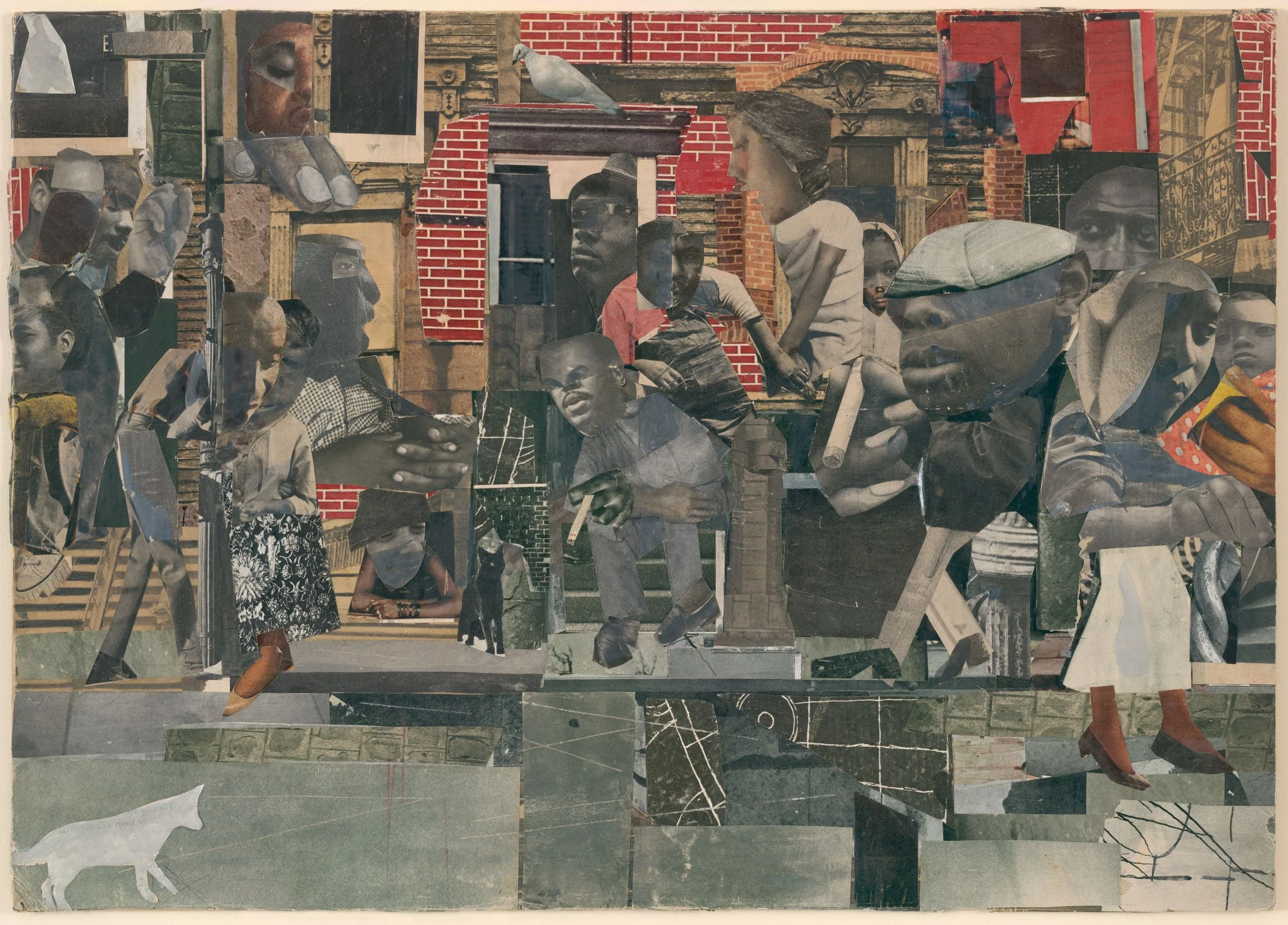
Romare Bearden. The Dove. 1964.
Physical violence (“guns and bombs”) and the trap of heroism
Empire’s armed incursion aims not only to kill rebels, but to sever survivors from their surrounds. Counterinsurgency’s primary objective is isolation: cutting people off from networks of care and luring them into spectacular forms of violent confrontation that make rebels legible enough to be identified, targeted, eliminated. The trap here is not cowardice but heroism. Spectacular resistance, the visible dramatic act, is precisely what counterinsurgency wants. Hollywood’s endless remakes of blockbuster rebellions (Star Wars among them) train us to romanticize the spectacle. The spectacle of rebellion turns the insurgent into a target and transforms the surround into an audience. The Black Panthers were not destroyed primarily for ostentatious displays of arms that singled them out, but for the breakfast programs and clinics that made them integral to their surrounds. The ostentatious displays were what made them targetable.
Cultural violence (“smoke and mirrors”) and the trap of counter-narrative
Empire reduces territories belonging to the surround to rubble and then places false signs upon the ruins to keep us from remembering what has been turned into rubble, and from recognizing ruins for what they are. But we remarked that this is the most vulgar form of smoke and mirrors. Empire does not excel at smoke and mirrors. We do. Ritual, myth, collective re-membering: these have long been techniques of the colonized, which Empire can only crudely imitate through spectacle. What colonialism calls “demystification” is often the destruction of practices it cannot absorb. The trap is the demand that we produce our counter-narratives in the form of spectacle: the pull to tell our own story in the arena of recognition, to correct the record, to contest Empire’s representations on Empire’s terms. The museum wants to include us. The curriculum wants to diversify. The algorithm wants our content. We begin seeking validation from the very apparatus that distorts us.
Institutional violence (“policies and procedures”) and the trap of appeal
Power often functions best without clearly articulated policies. The omnipresent threat of punishment compels people to interpret vague directives in the most oppressive ways in order to cover their ass. Trained to desire coverage, we ask, “Is there an institutional policy that I can appeal to in order to insure myself against misfortune?” rather than, “How do we plan to endure destitution in apposition to institutions?” The trap is the appeal. When threatened, we reach for policy. We demand our rights. We file grievances. We seek protection from the very apparatus that administers our exposure. This is recourse to Leviathan: the bargain that trades the surround for the state.
Carceral violence (“prisons and fortresses”) and the trap of moralism
The prison does not simply confine; it harvests. It scans for vulnerability, tags surplus life, and maps certain zones as reservoirs of supply. The pipeline to prison does not begin with sentencing but with selection: the calculus of who is available, which populations in which neighborhoods can be rendered disposable at scale. The trap is moralism. To cast prisoners as innocent victims is to reproduce the logic whose penalty is prison. The distinction between guilty and innocent is false; reversing it only reinforces the lie. The real divide is between those whose suffering is criminalized and those whose violence is named as law.
Behavioral violence (“carrots and sticks”) and the trap of becoming prescribed
Behavioral violence is what makes the other forms sustainable. If you can train people to police themselves, to feel shame before the stick appears, to crave the carrot before it is offered, the whole machine runs with minimal effort. The nervous system is rhythmic; it learns through repetition. The same plasticity that enabled ancestral attunement to the cycles of life and the seasons now makes us trainable by bell schedules, notifications, quarterly reviews. The trap is demanding that our breaks from the rhythms of Empire become prescribed. A break that has to prove itself repeatable is halfway to recapture. The grid learns; it updates; it absorbs. Carnival becomes tourism. Protest becomes content. Mutual aid becomes service learning.
These traps share a common structure: each involves becoming what Moten and Harney call a “political subject” in order to resist. The hero who confronts Empire. The storyteller who corrects the record. The rights-bearer who files the grievance. The moral witness who distinguishes innocent from guilty. The break that becomes routinized and turned into edifying or entertaining or self-empowering content for the culture industry. What returns, each time, is recourse to politics as self-possession.
So for each modality of violence, we can name both the trap and a counter-practice: entanglement that refuses capture.
Against physical violence: not the hero who stands out and ahead of the crowd in order to confront, but the caretaker who disappears into the crowd and dissolves into the surround. Again, the Panthers’ genius was not the guns but the clinics and breakfast programs that made them part of the commons, and COINTELPRO knew it. Self-defense of the surround means making the state irrelevant through care. The question shifts from “How do we fight back?” to “How do we become so entangled in each other’s survival that the threat of violence against ourselves—our individual persons—no longer disciplines us to seek separation from others?”
Against cultural violence: not the counter-narrator who corrects the inaccuracies and falsehoods that characterize imperial spectacle, but the ritualist who regenerates (under-)common rituals that re-member what Empire dis-members. Self-defense means protecting forms of re-membering that do not seek inclusion in the museum or the curriculum, practices that regenerate through use and decay, not preservation.
Against institutional violence: not the rights-bearer who appeals, but the planner who shimmies through. The migrant who crosses illegally on one side and claims asylum on the other is not contradicting themselves. They are planning. They acknowledge constraints without being confined by them. Self-defense means moving through the breaks where power contradicts itself, where policy is partial, where vague directives leave room to maneuver.
Against carceral violence: not the moral witness who distinguishes innocent from guilty, but the fellow prisoner who refuses the distinction. “A single dash of morality is enough to spoil any anti-carceral struggle.” Self-defense means recognizing shared captivity across holding zones without claiming equivalence: moving resources and care across the holds without producing the category of the innocent victim who deserves freedom.
Against behavioral violence: not the visible rebel whose break becomes viral content, but the quiet deviant who stays opaque. For those who have always been extended by the world, breaks can afford to be turned into best practices. For those never assured a place, the break often must stay obscure. Self-defense means protecting the breaks we cannot fully see, including our own.
And all of this begs the question: how do we defend these sessions themselves against becoming a form of political capture?
We gather routinely. Some of us read in advance. We discuss in structured time. We produce summaries. This is the rhythm of the seminar, the workshop, the reading group. Adhere to this rhythm too strictly and we risk becoming content. We risk producing ourselves as political subjects: the radicals, the critics, the resistance. We risk turning study into display.
Education produces students: subjects who acquire credentials, can be assessed, and are processed through an institutional pipeline. Study is what happens in the undercommons: being together in a way that produces nothing the institution can easily seize.
So the over-arching question for this session, and for all sessions henceforth, is whether and how it is we are studying rather than being educated; whether and how it is we are planning rather than producing policy. If we gather to study in service of the self-defense of our surround, we will do something beneath and beyond the production of manuals, manifestoes, or movements. We will produce something harder to capture: the capacity to care for each other in the face of the violences we have identified; the capacity to disappear when heroism is demanded; the capacity to keep moving when the camera wants us to stop, turn, and pose.
Here a different frame helps us gauge the effectiveness of what it is we are doing.
Sun Tzu names five factors that determine the outcome of any undertaking: the Way, the Weather, the Terrain, the Guides, and the Maneuvers. The lesson here concerns something prior to strategy and tactics: the conditions under which any undertaking can be sustained at all. Before embarking on any truly serious undertaking, we must ask whether genuine readiness exists, whether we have the actual capacity to persist through what is coming.
The question of study in the service of the self-defense of the surround requires this reframing. Again, Moten and Harney's provocation cuts to the heart of it: the real danger is not what Empire's violence does to us, but what we become in response. Self-defense that narrows into self-possession has already been captured. Resistance that seeks recognition from the state has already been absorbed. The surround cannot be defended by individuals seeking to secure themselves against it.
The Way
You know the Way when you can tell a compelling story about the undertaking, one that keeps you committed and draws others in. The Way is a story, a narrative that orients: where you came from, what you are doing, why it matters. Without the Way, effort dissipates. With the wrong Way, effort serves the wrong ends.
For the self-defense of the surround, the Way cannot be a story of self-possession. The hero's journey, a story of individual transformation and individual triumph, is precisely the narrative form Empire provides. The Way must be a story of entanglement: how we came to be bound up in each other's survival, how we remain so, how we will continue to be so regardless of what any individual chooses. It is not story that recruits followers to a leader's vision, but one that reminds everyone involved why they are already implicated.
What story commits us to resisting physical violence without making heroes of ourselves?
What story holds us in resisting cultural violence without seeking the arena of recognition?
What story orients resistance to institutional violence so that we refuse the appeal to rights?
What story sustains resistance to carceral violence without dividing the guilty from the innocent?
What story about resisting behavioral violence can be told without becoming a prescription? Must it remain, in part, untellable to remain alive?
The Weather
The Weather is favorable when there are no feelings you deny because they stand in your Way. Fear, grief, rage, despair: these are weather. Suppressing them does not make them disappear; it makes them operate underground, sabotaging from within. The question is not whether difficult feelings exist but whether they are acknowledged.
Favorable Weather means the storm you see coming is workable. The fear you name becomes information about where danger lies. The grief you allow moves through instead of calcifying into bitterness. The rage you acknowledge can be directed against Empire rather than turned against one another. Unfavorable Weather is not the presence of difficult feelings but their denial: performing confidence when terror is appropriate, performing unity when fracture is real.
What feeling drives us to confront force with force? Fear? Vainglory?
How do we experience the hunger for inclusion that clouds our resistance to cultural violence?
What feeling drives us toward appeals to policy rather than fugitive planning?
How do we experience the of feelings of guilt and innocence that spoil our resistance to carceral violence before it begins?
What feeling drives us to systematize the break—to prove it repeatable, to turn it into a method others can follow—and how does that feeling deliver resistance to behavioral violence back into the rhythms it meant to escape?
The Terrain
The Terrain is favorable when there are no facts you deny because they stand in your Way. Like Weather, this is not about pleasant circumstances but about honest acknowledgment. The terrain may be brutal—resources depleted, allies compromised, enemies ascendant—but brutal terrain honestly assessed is navigable. Terrain denied is terrain that kills.
Empire excels at producing false maps. The terrain it describes—where power lies, what is possible, who can be trusted—serves imperial interests. But the opposite error is equally fatal: counter-maps that show what we wish were true. Favorable Terrain means knowing the actual landscape, including the parts we would prefer not to exist.
Where do networks of care actually run and where does the surveillance apparatus see?
What practices survive without institutional support, and which have been destroyed beyond recovery?
Where does policy contradict itself, where is enforcement inconsistent, where are the gaps?
What is the actual geography of the hold—not just the prison but the halfway house that succeeds it, the surveilled block that precedes it?
What breaks remain unrepeatable, resistant to formalization, illegible to the grid that updates by learning what we do and absorbing it?
The Guides
You have trustworthy Guides when the theories informing your undertaking can account for the facts on the ground, the feelings in the air, and the turns of events you imagine possible along the Way. Theories that cannot account for facts are fantasy. Theories that cannot account for feelings are dissociated. Theories that cannot anticipate contingencies are brittle.
This is the most demanding condition. A trustworthy guide won’t make you feel good about your chances; its framework actually tracks what is happening. The test is predictive: when events unfold, does the theory help you understand them, or does it require constant revision and excuse-making? Trustworthy Guides have been tested against reality and not found wanting—not because reality is kind but because the framework is honest.
Do our guides explain how counterinsurgency produces the very hero it then targets?
How incorporation absorbs by including, how the curriculum neutralizes by diversifying?
How institutions run on contradiction rather than coherence and how contradiction opens routes?
How the carceral system generates the guilty/innocent distinction we are tempted to reverse?
How the grid captures not by forbidding breaks but by prescribing them?
The Maneuvers
You have practiced your Maneuvers when you have the developed skills to handle the turns of events that your Guides indicate are possible along the Way. Knowing what might happen is insufficient; one must have rehearsed responses. The body must know what to do when the mind is overwhelmed.
This is where theory meets practice, where understanding becomes capacity. The Maneuvers are not a single skill but a repertoire, shaped by the contingencies the Guides help anticipate. They develop through repetition, not inspiration. When the moment comes, you do not rise to the occasion; you fall to the level of your training.
Have we practiced care at scale: cooking, tending, moving resources? And what about opacity, acting without being identified?
Have we practiced the rituals that carry memory, and transmission without formalization into content?
Have we practiced reading bureaucracy, timing applications, finding the sympathetic functionary, and enduring without appeal while the route is found?
Have we practiced mutual aid across the holds without asking who deserves it?
Have we practiced breaking without prescribing the break? Have we developed the discipline of not turning our successful breaks into prescribable best practices?