Chickens Coming Home to Roost, II
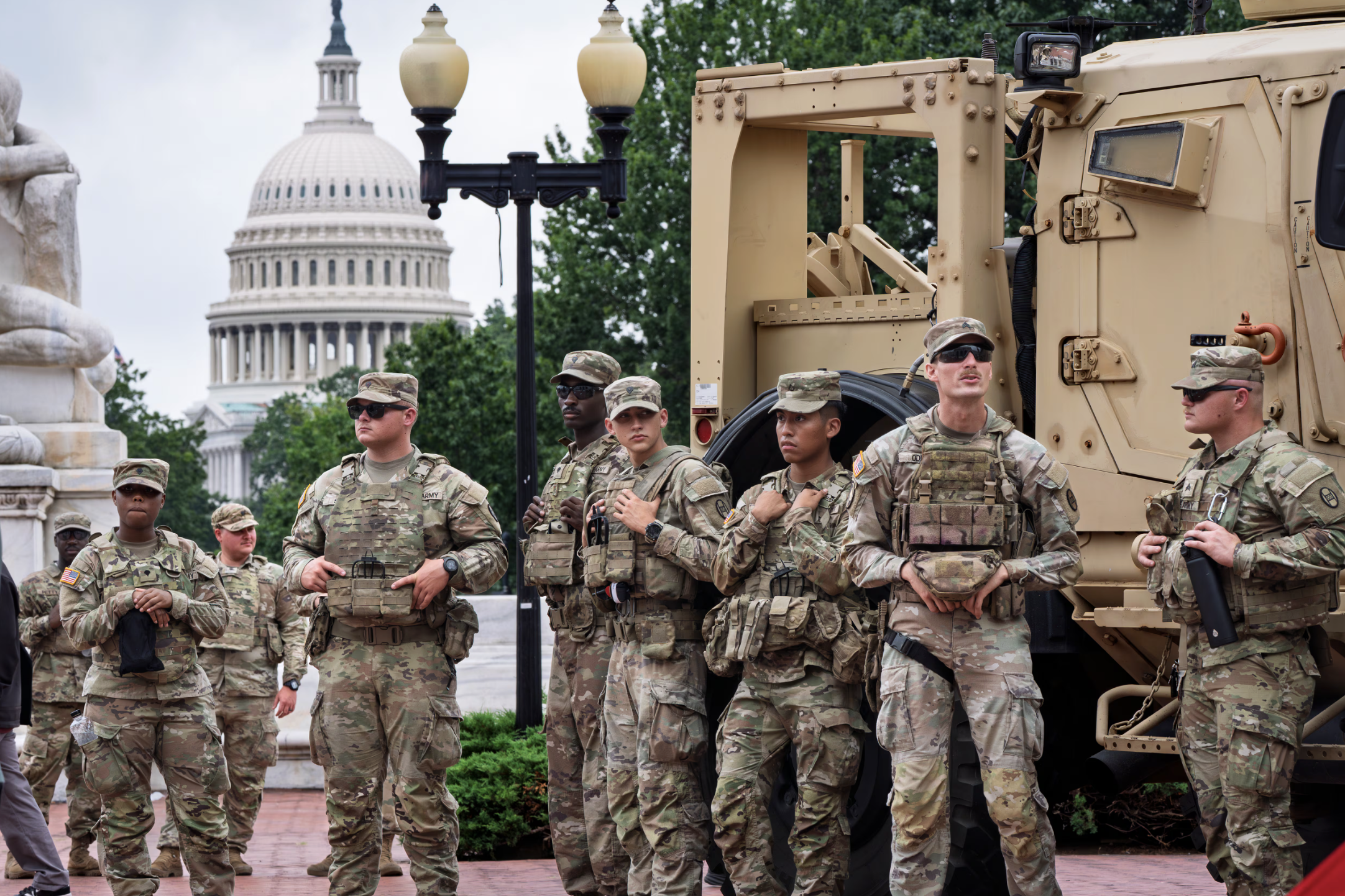
In an earlier dispatch, I argued that Trump’s deployment of National Guard troops to U.S. cities marks not a departure from liberal democracy into something wholly new, but a phase shift within a long fascist continuum. The “boomerang effect” brings colonial policing home; the borders between Green Zone and Grey Zone flex inward; populations ghettoized into internal colonies are treated as insurgents.
The question that returns, in light of recent events near the White House, is sharper and more uncomfortable: is the fascist state merely responding to crisis, or does it actively seek the kind of spectacular violence that will license further escalation?
When troops are inserted into the everyday — into subway stations, tourist districts, shelters, street corners — is the aim only “restoring order”? Or is there a quieter wager at work: that somewhere, some desperate person — migrant, refugee, “Ordinary Decent Criminal,” someone already stretched past the breaking point — will snap, and that this rupture can be instrumentalized?
The logic is one of retro-causation: insecure fascism is insecure because the crisis that would justify it has not yet arrived.
The recent shooting of two National Guard troops blocks from the White House, allegedly by an Afghan refugee, makes this wager visible. One soldier killed; another critically wounded; a refugee shooter, himself wounded; an instant declaration of “terror” from Trump; and within hours, an order for 500 more Guard troops to D.C. The cycle is brutally efficient: deployment → incident → moral panic → expanded deployment.
In the first dispatch, I leaned on George Jackson’s distinction between secure and insecure phases of fascism. Secure fascism governs primarily through “routine administration”: bureaucratic management, carceral containment, ideological consent, managed neglect, and murder by omission. Insecure fascism, by contrast, governs through terror: street-level violence, spectacular repression, the constant production of enemies, and murder by commission.
What the recent shooting clarifies is that insecure fascism organizes the conditions under which crisis becomes likely, then retrofits those crises into proof of its own necessity.
The presence of armed troops in a city’s everyday spaces — metro stations, tourist zones, encampments of the unhoused — is an active pressure:
It intensifies fear and humiliation for those already targeted.
It increases the day-to-day likelihood of encounter, confrontation, and escalation.
It signals to the Green Zone public, whites and honorary whites, that they are under threat, and that only militarized protection stands between them and chaos.
In this sense, the state places both its soldiers and its surplus populations into a shared kill zone of political risk. Any rupture — a shove, a thrown object, a pulled trigger — can be narrativized as confirmation: See? We told you they were dangerous. We told you we needed troops.
Consider the figure of Rahmanullah Lakanwal as he is now being reported: a 29-year-old Afghan man who entered the U.S. in the wake of the 2021 withdrawal, worked with C.I.A.-backed forces, and received asylum in April under Trump’s own administration.
This is important. The refugee who allegedly pulled the trigger stands at the hinge of empire’s double movement:
First, the U.S. devastates Afghanistan over decades: arming factions, occupying, bombing, torturing, destabilizing.
Then, in the chaos of withdrawal, it admits a fraction of Afghans under emergency programs, brings some into its own territory, and folds them into the precarious layers of the Grey Zone now dispersed inside the Green.
These refugees arrive already racialized as security risks and moral debtors: those we “saved,” those who “owe” the U.S. gratitude, those whose continued presence must be justified by good behavior, productivity, patriotism. Their very welcome is saturated with the threat of revocation.
When someone like Lakanwal, scarred by the traumas of his service to empire, picks up a gun, travels to a city that has been turned into a “front line,” and fires on National Guard troops, his figure is, structurally, primed to be read as the perfect enemy:
Muslim (or presumed Muslim)
Refugee / asylee
From a nation heavily associated with “terrorism” in U.S. discourse
Evacuated during the fall of Kabul, a scene Trump now theatrically holds up as proof of national humiliation
In one instant, a single act of violence is recoded as proof of an entire population’s untrustworthiness. The fascist state’s “I told you so” writes itself.
The state has:
Helped produce a global refugee population through war and neoliberal restructuring.
Admitted a small portion of that population under precarious terms.
Saturated public discourse with racialized panic about crime, migrants, and “terror.”
Inserted armed troops into civilian life under the banner of “protection.”
Given that set of conditions, the question is not if some desperate, unstable, or enraged individual will break. The question is when, and how quickly that break can be converted into license for more troops, more surveillance, more border enforcement, and now: more permanent exclusions encoded in immigration law.
The calculus is cold and cynical. The National Guard in this scenario serves a double function:
As shield, they embody protection for the imagined national subject: clear uniforms, visible guns, the comfort of preparedness for those who identify with them.
As bait, They are placed in locations where contact with the most precarious populations is guaranteed, their very presence a provocation to those for whom the uniform signals occupation, deportation, or death.
The state does not have to consciously sacrifice them. It only has to accept that some will be harmed or killed, and that such harm will strengthen its hand.
The fascist wager rests, in part, on a particular kind of overreaction: the desperate act of someone who has been relentlessly cornered.
We know this figure from prison writing, from working-class fiction, from the lore of the “Ordinary Decent Criminal”:
The undocumented worker facing deportation after a traffic stop.
The refugee whose temporary status is expiring with no path forward.
The hustler facing a third strike.
The person living under open criminalization of survival itself: selling loose cigarettes, sleeping on trains, trading sex, petty theft.
Under conditions of saturation policing, militarized presence, and administrative chokeholds, every day becomes an exercise in risk management. A shove instead of submission, a struggle instead of surrender, a gun drawn instead of hands up… None of these are laudable in themselves. They often backfire catastrophically. But they are intelligible as overreactions produced by overexposure to violence.
Insecure fascism depends on a steady supply of such overreactions, and it designs conditions in which they are statistically likely, then seizes on them rhetorically when they occur.
If you send National Guard troops into already-policed communities, already-targeted shelters, already-tense urban spaces, you are effectively running an experiment in escalation. You are increasing the number of armed interactions between the state and the most precarious.
Trump’s response in the forty-eight hours after the shooting is textbook.
In late-night social media blasts, he promises to “permanently pause migration from all Third World countries,” to strip U.S. citizenship from naturalized migrants who supposedly “undermine domestic tranquillity,” to cut off federal benefits to noncitizens, and to deport those deemed “non-compatible with Western Civilization.”
This is fascism’s appetite made explicit: it lives for the moment when an event can be stretched to cover the widest possible array of “enemies.” Indeed, it seems that the more loosely connected, the better: Afghans, Somalis, refugees, Muslims, “Third World” migrants, congresswoman in hijab, mayors and governors who welcome immigrants — all are folded into a single mass of threat.
If fascism has an appetite for crisis, if it is indifferent to the lives it burns through in order to feed its own escalation, then one imperative for those who oppose it is paradoxical: we have to refuse to give it the kind of crisis it knows how to use.
That does not mean submitting quietly to occupation, nor does it mean moralizing against certain forms of resistance. It means, rather, being clear-eyed about the scripts already waiting for us.
If insecure fascism wants a particular kind of spectacular enemy, the task for those of us engaged in anything akin to “fugitive planning” is to become unintelligible/invisible to that desire.