A Fugitive Planner's Guide to Empire?
We're coming to the end of the third year and third sequence of the AGAPE (Against Global Apartheid and Planetary Ecocide) research group, and I'd like our upcoming session to be a self-reflexive one: an opportunity to consider what we've been doing together and what we have become capable of doing, making, thinking, and feeling as a consequence of our gatherings.
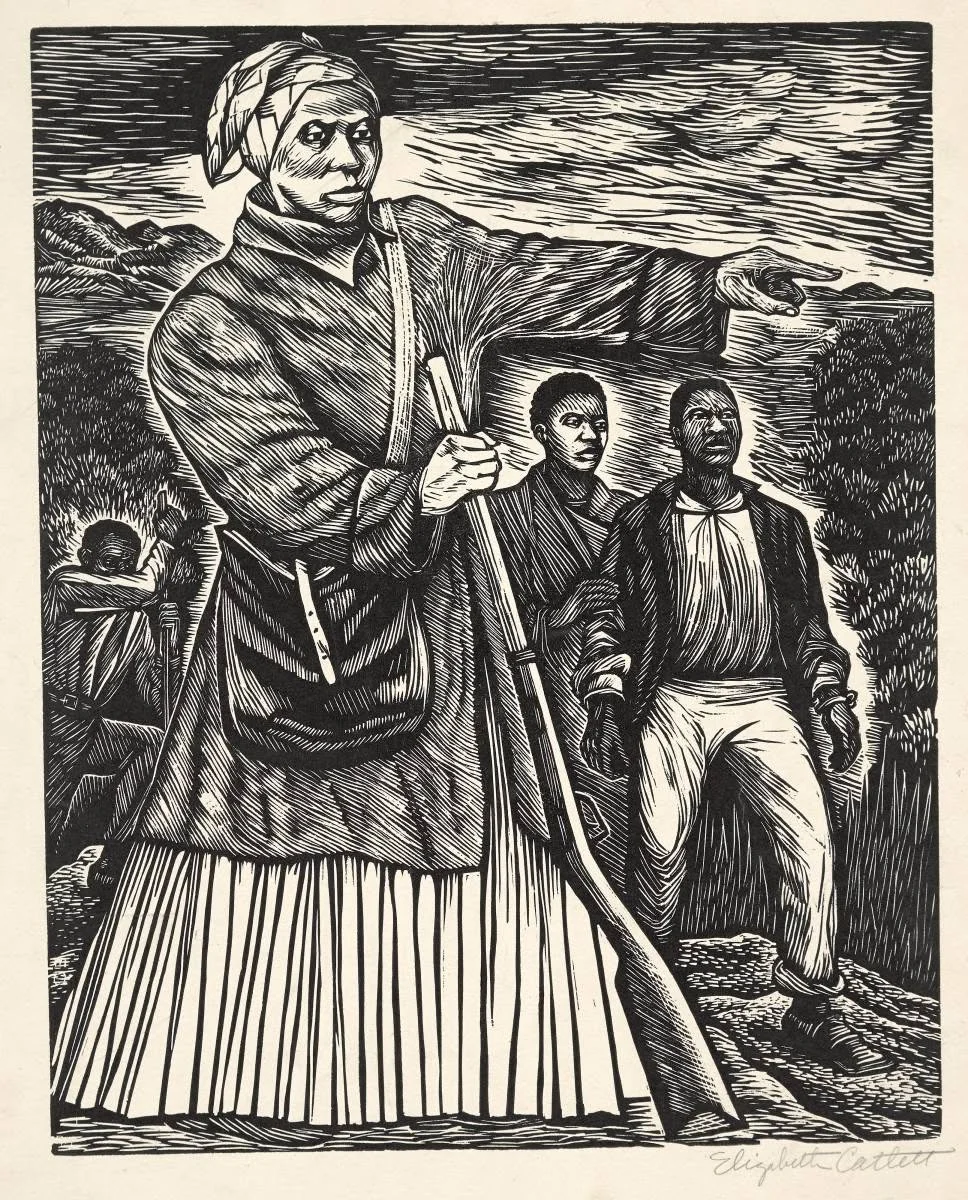
Elizabeth Catlett, Untitled (Harriet Tubman) (1953). Rifle in hand, Harriet Tubman points the way as those she has led out of slavery follow close behind.
Our first sequence, which began in late 2023, was devoted to becoming wise to the workings of Empire. We traced its historical genesis and changing infrastructural arrangements, examining the racial and environmental fractures that sustain Global Apartheid and Planetary Ecocide. In so doing, we considered how the processes of colonization and enslavement can persist long after their formal institutional products—the colony and the slave, as legally sanctioned categories—have been dispensed with, and how the remnants, residues, reverberations, and arrangements left in their wake continue to devastate peoples and places. At the same time, drawing upon the histories and legacies of Indigenous peoples, Maroons, and other fugitives from Empire, we began to investigate the possibilities of recognition, recollection, resistance, and repair: practices through which we might counter the dismemberment of convivial relations and participate in the making of an Entangled World.
Our second sequence, in 2025, turned to the means by which Empire represses such undertakings. We examined five interlocking modalities of imperial violence (physical: guns and bombs; cultural: smoke and mirrors; institutional: policies and procedures; carceral: prisons and fortresses; and behavioral: carrots and sticks) and considered the practices through which those subjected to these violences might resist or evade them. As our investigations unfolded, however, we became increasingly concerned with something else: the manner in which resistance itself can become subsistence for the imperial machine. We found that each modality of violence baits those it targets, inviting forms of resistance that draw them back into the very arrangements of domination they seek to dismantle. Beyond simply defending ourselves against imperial violence lies the problem of how to do so without our defenses reproducing the very forms of power that occasioned them.
That question brought us to our third sequence, in 2026, which we have organized around five factors borrowed and adapted from Sun Tzu: the Way, the Weather, the Terrain, the Guides, and the Maneuvers. Rather than convening primarily to read and discuss texts, we are now gathering to share something of our actual conditions for undertaking and sustaining practices of recognition, recollection, resistance, and repair. What are the Ways that orient us? What Weather are we contending with? What Terrain are we traversing? Whose Guidance do we trust? What Maneuvers have we practiced, and what remains for us to learn?
In April, we shared stories of our Ways, discovering how the Ways we make for ourselves are always provisional and forever bound up with those of others whose lives we cannot simply disentangle from our own. In June, we turned to the Weather, attending to the feelings that condition our undertakings and recognizing that favorable Weather is not the absence of fear, grief, rage, or despair, but a refusal to deny what we are actually feeling and a commitment to examining closely how we come to feel as we do. In September, we considered the Terrain, coming to distinguish the apparent topography of a place from the field of forces that becomes sensible through our encounters with it. Now, in November we turn to Guides, before concluding in December with Maneuvers: the practiced capacities through which we prepare ourselves to handle the turns of events that our Guidance indicates we might encounter along our Ways.
But for me, the question of Guides brings us back to what this entire undertaking was about in the first place.
When I first convened AGAPE, I wanted to cultivate guides to Empire for fugitive planners: for the denizens of what Fred Moten and Stefano Harney call the undercommons, for those engaged in Black study and fugitive planning, for those whose undertakings concern the recognition, recollection, resistance, and repair of worlds devastated by patriarchal imperialism and racial capitalism.
Empire has no shortage of guides. Its imperialists and colonizers, their proxies and self-appointed redeemers, rely upon historians, economists, military strategists, social scientists, engineers, and policy experts to help them navigate the world in pursuit of their powers and privileges. These guides may possess a profound understanding of the world they seek to command, but their expertise is cultivated in the service of accumulation and control. They learn to recognize those features of the world that can be turned into instruments of domination. They map territories in order to occupy them, populations in order to administer them, and flows of matter, energy, labor, and information in order to channel them into profitable and productive circuits. Their guidance is often remarkably effective, which is precisely why we must understand how it works.
Those who oppose Empire have their guides, too. Marxists have developed formidable accounts of capitalist exploitation and imperialist accumulation. Anarchists have cultivated traditions of resistance to institutionalized authority. Anti-colonial and Black radical thinkers have provided indispensable understandings of the workings of racializing rule and the possibilities of collective liberation. Indigenous peoples have sustained bodies of ecological knowledge through which we might learn to inhabit the Earth without presuming to command it. We have drawn extensively upon these traditions throughout AGAPE, and there is much more for us to learn from them.
But, as I see it, the point of our undertaking was never simply to gather these bodies of knowledge into a more comprehensive account of Empire. I wanted us to cultivate the capacities to recognize how Empire works so that we ourselves might better serve those who seek to desert it: those attempting to live, move, make, and dwell in ways that refuse its pathological demands for separation, accumulation, command, and control.
This is why our first sequence involved both a genealogy and a structural analysis of Empire. We wanted to understand how the world we inhabit came to be organized as it is, and how the arrangements produced through centuries of conquest and exploitation continue to condition our possibilities of living otherwise. Yet this knowledge was never intended to remain a matter of historical or theoretical expertise. The point was to cultivate ourselves as people capable of recognizing the workings of Empire in the particular circumstances in which we encounter them, so as to help ourselves and our fellow fugitive planners negotiate those circumstances without becoming instruments of the powers we seek to evade.
Much of our work has involved reading and writing, producing primers, session reflections, essays, dispatches, and various other intellectual and aesthetic artifacts. I gathered some of the material from our first sequence into a collection bearing the subtitle A Fugitive Planner's Guide to Empire. But the title lends itself to a peculiar metonymic displacement, one that becomes especially troubling in light of our present inquiry. We have become accustomed to calling a guidebook a guide, as if the written product of someone's knowledge could stand in for a guide capable of exercising that knowledge.
A guidebook can describe a Terrain, but it cannot encounter that Terrain. It can preserve accounts of changing Weather, but it cannot feel the rain. It can record routes taken by others, but it cannot determine whether those routes remain passable under present circumstances. Nor can it recognize when its own descriptions have become inadequate, except insofar as someone capable of exercising judgment takes it up, tests it against what they encounter, and alters or abandons its Guidance accordingly.
A guide need not be a person, or even sentient, but it must be sensitive to changing circumstances in ways that can inform how others make their Ways.
Here we might recall a distinction with which our first sequence began: that between an ideology, a process, the product of a process, and its wake. We made this distinction to understand how processes of colonization could continue to reproduce coloniality even when the ideologies that justified them had been disavowed and the colonies they produced formally abolished. It is worth turning the distinction upon ourselves.
Our writings are among the products of AGAPE. Our gatherings, and the practices of study, conversation, reflection, and collaboration that have taken place through them, constitute the process. What, then, has this process produced in us and among us? What remains in its wake? Have we become more capable of recognizing Empire's workings? Have our relations to the worlds we inhabit changed? Have we cultivated capacities for recollection, resistance, and repair that we would otherwise have lacked? Have we become more trustworthy guides to Empire for fugitive planners?
Or have we merely become better at talking and writing about Empire?
Next Session: 22 November 2026
Start Time : 10:30 LA / 12:30 Chicago / 13:30 NYC / 15:30 São Paulo / 18:30 London / 19:30 Berlin / 21:30 Dar es Salaam / 23:59 Delhi
End Time: 12:30 LA / 14:30 Chicago / 15:30 NYC / 17:30 São Paulo / 20:30 London / 21:30 Berlin / 23:30 Dar es Salaam / 02:00 Delhi
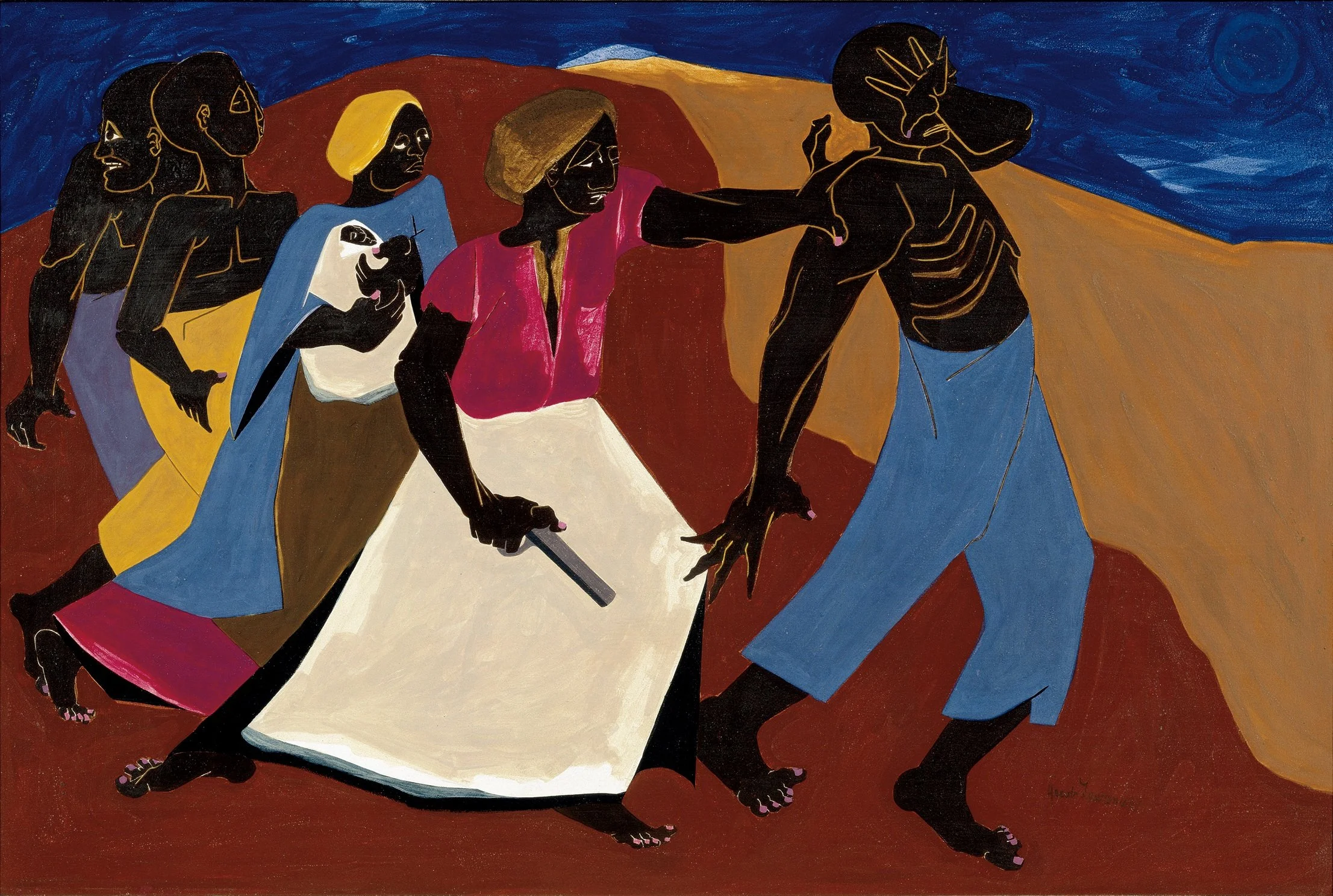
Jacob Lawrence, Forward (1967). Harriet Tubman urges a group of people fleeing slavery onward through the night.